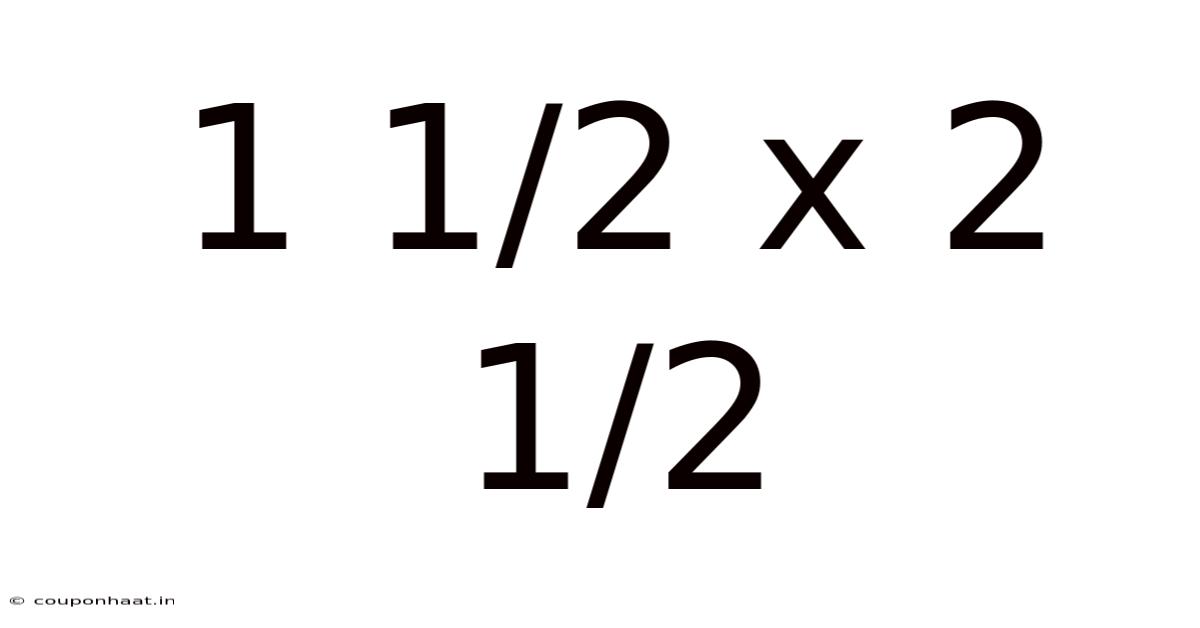
Decoding 1 1/2 x 2 1/2: A Deep Dive into Dimensions, Applications, and Practical Uses
The seemingly simple dimensions "1 1/2 x 2 1/2" represent a surprisingly versatile size with a wide range of applications across various fields. This article will explore the significance of these dimensions, look at their practical uses, and provide a comprehensive understanding of their implications in different contexts. We will also examine the mathematical underpinnings and explore potential scenarios where this size matters a lot. Whether you're a DIY enthusiast, a professional designer, or simply curious about the practical implications of seemingly mundane measurements, this exploration will offer valuable insights.
No fluff here — just what actually works.
Understanding the Dimensions: 1 1/2 x 2 1/2
The dimensions 1 1/2 x 2 1/2, often expressed as 1.In real terms, 5, represent a rectangular area. Day to day, 67) isn't a particularly unique or mathematically significant ratio, unlike, say, the golden ratio. Plus, 5 x 2. The significance of these specific numbers lies not in their inherent mathematical properties, but in their practical relevance in various applications. The ratio between the two dimensions (approximately 1:1.On the flip side, its practicality stems from its suitability for a variety of everyday objects and projects. The dimensions' usefulness hinges on their adaptability to different scales and contexts Took long enough..
Remember that these numbers represent length and width and the units are not specified. In practice, they could be inches, centimeters, meters, or even feet – the context dictates the units of measurement. This ambiguity highlights the inherent flexibility of these dimensions The details matter here..
Practical Applications: Where 1 1/2 x 2 1/2 Shines
The versatility of 1 1/2 x 2 1/2 dimensions is remarkable, finding applications across a wide spectrum of fields:
1. Construction and Home Improvement:
- Tile sizing: Many ceramic tiles are available in sizes close to or slightly deviating from 1.5 x 2.5 inches or centimeters, making this size particularly common in tiling projects. The slightly rectangular shape is often visually appealing and practical for covering surfaces.
- Woodworking: In woodworking projects, 1 1/2 x 2 1/2 inches (or centimeters) can represent the dimensions of small wooden blocks, slats, or components within larger structures. These sizes are frequently used for crafting, model making, and various carpentry tasks.
- Framing and Molding: Custom-made frames or moldings might incorporate these dimensions for their aesthetic appeal or to fit specific spaces. The aspect ratio allows for a visually pleasing balance.
2. Packaging and Product Design:
- Boxes and containers: This size can be ideal for packaging smaller items like candies, jewelry, or small electronic components. The compact size minimizes shipping costs and storage space while ensuring sufficient product protection.
- Labels and Stickers: Many labels and stickers adhere to similar proportions, particularly those used on smaller products or for specific identification purposes. This is dictated by both aesthetics and practical considerations of the label's positioning.
- Cardboard Inserts: Custom-designed cardboard inserts often work with dimensions near 1 1/2 x 2 1/2 to protect fragile items during shipping or storage.
3. Graphic Design and Printing:
- Business cards: Although the standard size varies regionally, 1 1/2 x 2 1/2 inches, or a close approximation, may be considered for business cards in specific designs or specialized applications.
- Postcards and Invitations: The dimensions could work for smaller-format postcards or invitations, though this application is less common due to established industry standards.
- Flyers and Brochures: While not standard, a 1.5 x 2.5 inch size could be used as a small insert within a larger brochure.
4. Other Applications:
- Fabric cutting: In sewing and quilting, this could represent the size of a small patch or a component within a larger piece of fabric.
- Hobby and Craft Projects: From scrapbooking to model building, these dimensions frequently appear in countless DIY projects that rely on precise measurement and material cutting.
Mathematical Considerations: Exploring the Ratios and Scalability
While 1 1/2 x 2 1/2 doesn't represent a particularly notable mathematical ratio (like the golden ratio or the Fibonacci sequence), its scalability is noteworthy. The dimensions can be easily multiplied or divided to create larger or smaller versions, maintaining the aspect ratio. For instance:
- Doubling: 3 x 5
- Halving: 0.75 x 1.25
- Tripling: 4.5 x 7.5
This scalability allows for adaptability in various projects where the proportions need to remain consistent but the overall size needs to change. The consistent aspect ratio ensures visual harmony regardless of the scale Took long enough..
Beyond the Numbers: Visual Impact and Design Aesthetics
The dimensions of 1 1/2 x 2 1/2, while seemingly insignificant, can have a subtle but discernible impact on the visual perception of a design or product. Worth adding: the slight rectangular nature contributes to a sense of balance and harmony. This aspect ratio isn't overwhelming, yet it is distinct from a square, providing a degree of visual interest. It's neither too elongated nor too squat, creating a sense of visual equilibrium. This contributes to the practicality and aesthetic appeal in the applications mentioned above.
Frequently Asked Questions (FAQs)
Q: What units are usually associated with 1 1/2 x 2 1/2 dimensions?
A: The units are context-dependent. Also, they could be inches, centimeters, millimeters, or even feet, depending on the application. It's crucial to always specify the unit of measurement for clarity.
Q: Are these dimensions standard for any specific product or application?
A: While not a universally standardized size like A4 paper or a standard brick, 1 1/2 x 2 1/2 dimensions are commonly encountered in many applications, often as an approximation or a convenient size for specific uses.
Q: How can I use these dimensions in my own projects?
A: The application depends on your project. Plus, consider your material, the intended function, and the overall design before incorporating these dimensions. Sketching or using design software can help visualize how these dimensions integrate into your project.
Q: What are the limitations of using 1 1/2 x 2 1/2 dimensions?
A: The limitations are primarily contextual. They might not be suitable for large-scale projects or where standardized sizes are mandatory (e.g., building regulations). Beyond that, the exact dimensions might require slight adjustments depending on the material and manufacturing process.
Conclusion: The Unsung Importance of 1 1/2 x 2 1/2
The seemingly ordinary dimensions of 1 1/2 x 2 1/2 possess a surprising degree of versatility and practical significance across a variety of fields. So naturally, from construction and packaging to graphic design and crafting, these dimensions demonstrate the importance of seemingly small details in shaping our world. Still, understanding the potential of these dimensions allows for better decision-making in various projects, leading to more efficient designs, improved functionality, and ultimately, more successful outcomes. Which means their adaptability, scalability, and subtle impact on visual aesthetics contribute to their widespread use and highlight how seemingly simple measurements can have profound implications in a range of practical applications. The next time you encounter these dimensions, remember the diverse world of applications they quietly support Simple as that..
This is the bit that actually matters in practice.
