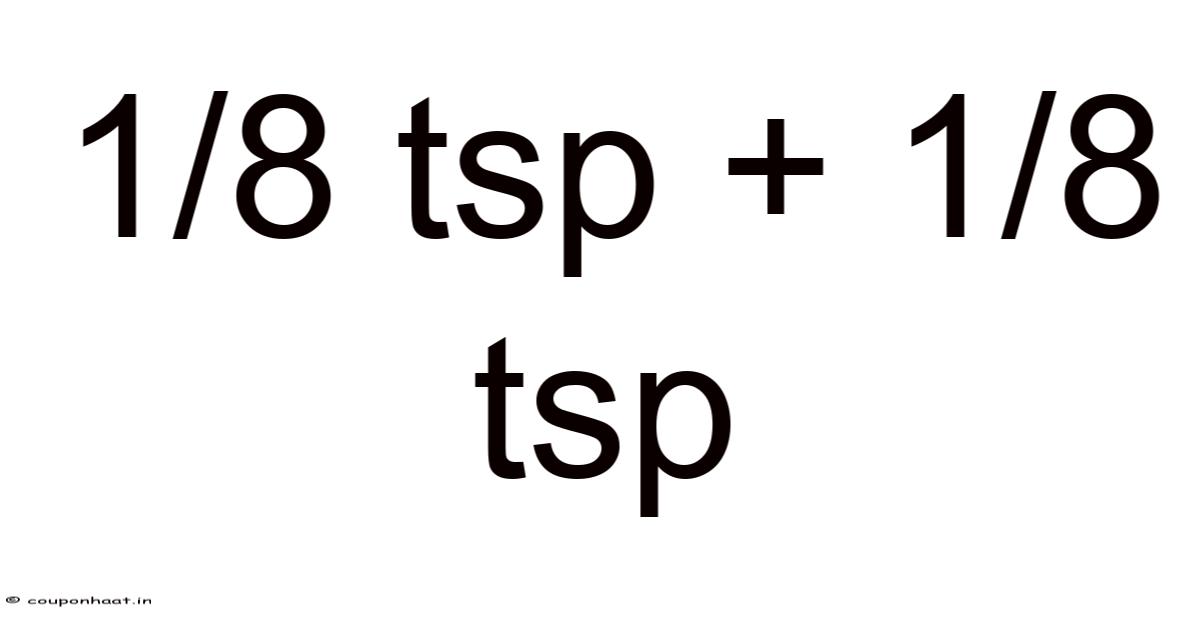
Decoding the Mystery of 1/8 tsp + 1/8 tsp: A Deep Dive into Fractions, Measurement, and Culinary Precision
Understanding fractions might seem like a relic of school days, a topic relegated to dusty textbooks. Still, the simple addition of 1/8 tsp + 1/8 tsp is far more relevant than you might think, touching upon fundamental mathematical principles and holding practical significance in various fields, particularly in cooking and baking. This article will get into the seemingly simple equation, exploring its mathematical basis, its practical applications, and the broader implications of precise measurement.
Introduction: Why Precision Matters
At first glance, 1/8 tsp + 1/8 tsp seems trivial. But the significance of this seemingly simple addition extends beyond the basic arithmetic. Which means understanding fractions and their applications enables us to achieve accuracy and consistency, leading to improved results and a deeper appreciation for the interplay between mathematics and the practical world. Precision in measurement is key in various disciplines, from scientific experiments requiring precise chemical dosages to the culinary arts where subtle variations in ingredients can dramatically impact the final product. The answer, 2/8 tsp or its simplified form, 1/4 tsp, is easily calculated. This article will serve as your guide to fully understanding this seemingly simple equation and its wider implications Still holds up..
Understanding Fractions: A Refresher
Before diving into the addition itself, let’s revisit the concept of fractions. A fraction represents a part of a whole. It consists of two numbers: the numerator (the top number) and the denominator (the bottom number). The denominator indicates the number of equal parts the whole is divided into, while the numerator specifies how many of those parts are being considered. In our example, 1/8 tsp represents one out of eight equal parts of a teaspoon Not complicated — just consistent. And it works..
This understanding forms the bedrock of adding fractions. We cannot simply add the numerators and denominators directly. The key is to see to it that both fractions share the same denominator—a concept known as finding a common denominator.
Adding Fractions: A Step-by-Step Guide
Adding 1/8 tsp + 1/8 tsp is a straightforward process because both fractions already have a common denominator (8). The steps are as follows:
-
Identify the common denominator: In this case, both fractions have a denominator of 8 And that's really what it comes down to..
-
Add the numerators: Add the numerators together: 1 + 1 = 2.
-
Retain the common denominator: The denominator remains 8 Small thing, real impact..
-
Simplify the fraction (if possible): The resulting fraction is 2/8. This fraction can be simplified by dividing both the numerator and the denominator by their greatest common divisor, which is 2. This gives us 1/4 Surprisingly effective..
That's why, 1/8 tsp + 1/8 tsp = 2/8 tsp = 1/4 tsp.
Practical Applications: From Baking to Science
The seemingly simple addition of 1/8 tsp + 1/8 tsp has numerous practical applications, especially in fields that demand precision:
-
Baking: In baking, even small variations in ingredient quantities can significantly affect the outcome. A recipe might call for 1/8 tsp of baking soda in one step and another 1/8 tsp in a later step. Precise measurement is crucial to achieve the desired texture and rise of the baked good. Inaccurate measurements can lead to a flat cake, tough cookies, or a bread that doesn't rise properly. Understanding the addition of fractions ensures the baker accurately measures and combines ingredients, leading to consistent and successful results.
-
Cooking: While cooking might allow for more flexibility compared to baking, precise measurements are still essential for achieving consistent flavor and texture. Recipes often involve small quantities of spices or flavorings, and using fractions correctly allows for accurate replication of a recipe's intended taste. A difference of even 1/8 tsp of a potent spice can significantly alter a dish’s flavor profile.
-
Pharmacology and Medicine: In medicine and pharmacology, precision is essential. Incorrect dosages of medication can have severe consequences. Medical professionals regularly work with incredibly small measurements, often involving fractions, ensuring patients receive the appropriate and safe amount of medication. Accurately calculating dosages and administering them requires a firm grasp of fractions and precise measurement techniques.
-
Chemistry and Scientific Experiments: In scientific experiments, particularly those involving chemical reactions, precise measurement is non-negotiable. Incorrect measurements can lead to flawed results, failed experiments, and even safety hazards. Scientists often use highly sensitive instruments to ensure accurate measurement of substances down to tiny fractions of a unit, guaranteeing the validity and reliability of their findings.
-
Engineering and Construction: Even in large-scale projects like engineering and construction, precision in measurements is critical. Minor discrepancies in dimensions can lead to significant problems, affecting structural integrity, functionality, and aesthetics. Engineers and architects work with precise measurements to ensure structures are built according to specifications and meet safety standards.
Beyond the Basics: Exploring More Complex Fractional Calculations
While 1/8 tsp + 1/8 tsp provides a simple introduction, adding fractions can become more complex when dealing with unequal denominators. On the flip side, for instance, consider adding 1/8 tsp + 1/4 tsp. Consider this: in this case, we need to find a common denominator before adding the numerators. But the least common multiple of 8 and 4 is 8, so we convert 1/4 to an equivalent fraction with a denominator of 8: 1/4 = 2/8. Now we can add: 1/8 + 2/8 = 3/8 That's the part that actually makes a difference..
Not the most exciting part, but easily the most useful.
This illustrates the importance of understanding the fundamental principles of finding common denominators and simplifying fractions to tackle more complex fractional calculations.
Measurement Tools and Techniques for Accuracy
Achieving accurate measurements when working with small quantities like 1/8 tsp requires the right tools and techniques. While a standard teaspoon measure might not provide sufficient precision, several options can help achieve better accuracy:
-
Measuring Spoons: Invest in a set of measuring spoons that includes 1/8 tsp increments. These spoons are specifically designed for precise measurements of small quantities of ingredients.
-
Digital Kitchen Scales: For ultimate precision, a digital kitchen scale is invaluable. While it might not be practical for every culinary task, it is especially useful when working with small quantities of ingredients or when consistency is essential. Scales offer precise measurements in grams or ounces, enabling greater accuracy than standard measuring spoons.
-
Leveling Techniques: When using measuring spoons, it's crucial to use a leveling technique to ensure you're not adding excess ingredient. Use a straight-edged spatula or knife to scrape off any excess ingredient from the spoon, ensuring a perfectly level measure That's the part that actually makes a difference..
-
Proper Handling: Avoid packing ingredients into measuring spoons; this leads to inaccurate measurements. Spoon the ingredient lightly into the measuring spoon Worth keeping that in mind..
Frequently Asked Questions (FAQ)
Q: Can I use a different unit of measurement instead of teaspoons?
A: Yes, you can. Now, the principle of adding fractions remains the same regardless of the unit of measurement. If working with milliliters (ml) or grams (g), you'll follow the same steps of finding a common denominator and adding the numerators Small thing, real impact. But it adds up..
Q: What if I don't have a 1/8 tsp measuring spoon?
A: You can estimate 1/8 tsp using a 1/4 tsp spoon. Simply fill the 1/4 tsp spoon halfway. Even so, remember that this is an estimation and might not provide perfect accuracy.
Q: Why is precision important in baking but not as critical in cooking?
A: While precision is beneficial in both, it is more critical in baking because chemical reactions play a more significant role. In baking, the precise ratios of ingredients affect the rise, texture, and overall success of the baked good. Cooking offers more flexibility as it often relies less on precise chemical reactions and more on the blending of flavors and textures.
Q: How can I improve my skills in working with fractions?
A: Practice is key. Start with simple addition problems, gradually increasing the complexity. Online resources, workbooks, and educational apps offer excellent opportunities to hone your fractional skills. In the kitchen, actively measure ingredients using fractions, paying attention to accuracy and consistency.
Conclusion: The Power of Precision
While the equation 1/8 tsp + 1/8 tsp might seem insignificant at first glance, it underscores the importance of precise measurement and the fundamental principles of fractions. On the flip side, by understanding and applying this knowledge, we can achieve higher levels of accuracy, consistency, and success in our endeavors, whether it's baking a perfect cake or conducting a crucial scientific experiment. On the flip side, this seemingly simple addition has significant implications in diverse fields, from the culinary arts to scientific research, highlighting the practical value of mastering basic mathematical concepts. The power of precision lies in the details, and mastering fractions is a crucial step toward achieving it.
