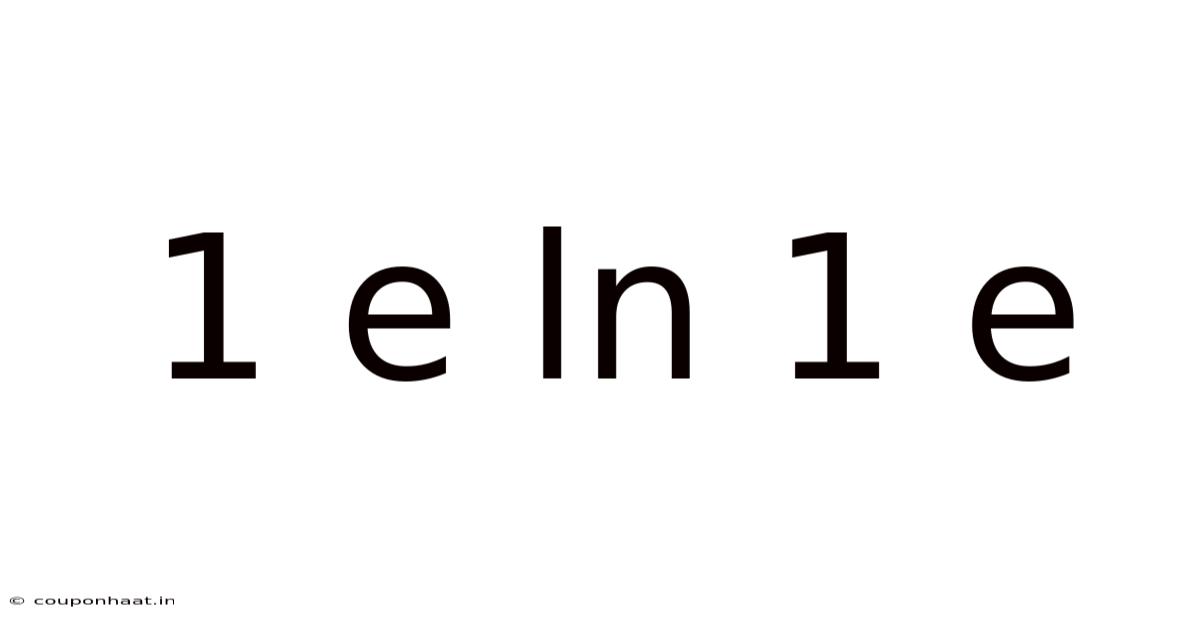
Unraveling the Mystery: 1 * e^(ln 1) * e
The expression "1 * e^(ln 1) * e" might seem intimidating at first glance, particularly for those less familiar with logarithmic and exponential functions. On the flip side, this seemingly complex expression simplifies dramatically when we understand the fundamental relationship between the exponential function (e^x) and the natural logarithm (ln x). Even so, this article will break down the expression step-by-step, explaining the underlying mathematical principles, and ultimately revealing its surprisingly simple solution. We'll explore the properties of logarithms and exponentials, address potential points of confusion, and even break down some related mathematical concepts. By the end, you'll not only understand the solution to this specific problem but also gain a deeper appreciation for the elegance and interconnectedness of mathematical functions.
Understanding the Fundamentals: e and ln x
Before we tackle the expression, let's refresh our understanding of the key players: e and ln x.
-
e (Euler's number): e is a mathematical constant, approximately equal to 2.71828. It's the base of the natural logarithm and is key here in calculus, particularly in exponential growth and decay models. It's an irrational number, meaning its decimal representation goes on forever without repeating.
-
ln x (Natural logarithm): The natural logarithm, denoted as ln x, is the logarithm to the base e. In simpler terms, ln x answers the question: "To what power must e be raised to obtain x?" As an example, ln e = 1 because e¹ = e. The natural logarithm is the inverse function of the exponential function e^x No workaround needed..
Deconstructing the Expression: 1 * e^(ln 1) * e
Now, let's break down the expression 1 * e^(ln 1) * e step-by-step:
-
ln 1: This is the first step. What power must e be raised to equal 1? The answer is 0. Which means, ln 1 = 0 But it adds up..
-
e^(ln 1): Substituting the result from step 1, we get e⁰. Any number (except 0) raised to the power of 0 equals 1. That's why, e⁰ = 1.
-
1 * e^(ln 1) * e: Substituting the result from step 2, the expression becomes 1 * 1 * e, which simplifies to simply e Worth keeping that in mind..
That's why, the solution to 1 * e^(ln 1) * e is e.
A Deeper Dive: Properties of Logarithms and Exponentials
The solution hinges on the fundamental properties of logarithms and exponential functions. Let's explore these properties further:
-
Inverse Relationship: The natural logarithm (ln x) and the exponential function (e^x) are inverse functions of each other. So in practice,:
- e^(ln x) = x (for all x > 0)
- ln(e^x) = x (for all x)
This inverse relationship is the key to simplifying the expression. We used the property e^(ln x) = x when we simplified e^(ln 1) to 1 That alone is useful..
-
Logarithm Rules: Understanding logarithm rules is crucial for manipulating logarithmic expressions. Some key rules include:
- ln(xy) = ln x + ln y
- ln(x/y) = ln x - ln y
- ln(xⁿ) = n ln x
These rules are particularly useful when dealing with more complex logarithmic expressions Not complicated — just consistent..
-
Exponential Rules: Similar to logarithms, exponential functions have their own set of rules:
- e^(x+y) = e^x * e^y
- e^(x-y) = e^x / e^y
- (e^x)^y = e^(xy)
These rules are essential for simplifying and manipulating exponential expressions.
Illustrative Examples: Applying the Concepts
Let's consider some similar examples to solidify our understanding:
Example 1: 2 * e^(ln 2) * e
Following the same steps:
- ln 2 ≈ 0.693
- e^(ln 2) = 2
- 2 * 2 * e = 4e
Which means, 2 * e^(ln 2) * e = 4e
Example 2: e^(ln 5) / e^(ln 2)
Using the exponential rule e^(x-y) = e^x / e^y and the inverse relationship:
- e^(ln 5) / e^(ln 2) = e^(ln 5 - ln 2)
- Using the logarithm rule ln(x/y) = ln x - ln y: e^(ln 5 - ln 2) = e^(ln(5/2))
- Using the inverse relationship e^(ln x) = x: e^(ln(5/2)) = 5/2
Which means, e^(ln 5) / e^(ln 2) = 5/2
Addressing Potential Points of Confusion
A common point of confusion arises when dealing with the logarithm of 0 or negative numbers. But the natural logarithm, ln x, is only defined for positive values of x. So, expressions like ln 0 or ln(-1) are undefined. This is because there's no power to which e can be raised to yield 0 or a negative number. e raised to any power will always be a positive number.
Another point of confusion might be the difference between natural logarithms (ln x) and logarithms with other bases (like log₁₀ x or log₂ x). Remember that ln x specifically refers to the logarithm to the base e Simple, but easy to overlook..
Frequently Asked Questions (FAQ)
Q: Why is e such an important number in mathematics?
A: e appears naturally in many areas of mathematics and science, particularly in calculus, exponential growth and decay, and probability. Its unique properties make it fundamental to understanding various phenomena That's the part that actually makes a difference..
Q: Can I use a calculator to solve this type of problem?
A: While a calculator can help with numerical approximations (like finding the approximate value of e), understanding the underlying mathematical principles is crucial for solving these problems efficiently and accurately. A calculator might give you a numerical approximation of e, but it won't necessarily show you the steps involved in simplifying the expression Turns out it matters..
Q: What if the expression was more complex, involving multiple logarithmic and exponential terms?
A: For more complex expressions, you'll need to systematically apply the rules of logarithms and exponentials, simplifying step-by-step until you reach a simplified form. Remember to always follow the order of operations (PEMDAS/BODMAS) Which is the point..
Q: Are there other mathematical constants as significant as e?
A: Yes, other significant mathematical constants include π (pi), approximately 3.14159, which represents the ratio of a circle's circumference to its diameter; and i (the imaginary unit), defined as the square root of -1, which is fundamental to complex numbers.
Conclusion
The expression 1 * e^(ln 1) * e, while initially appearing complex, simplifies elegantly to e through the application of fundamental properties of logarithms and exponential functions. This exploration serves not only to provide the solution but also to strengthen your understanding of these crucial mathematical concepts and their interconnections. Understanding the inverse relationship between ln x and e^x, coupled with the rules governing logarithmic and exponential manipulations, is key to solving such problems. By grasping these fundamental principles, you'll be well-equipped to tackle more complex mathematical challenges involving logarithmic and exponential functions. Remember that mathematical proficiency often comes from a combination of understanding fundamental rules, practiced application, and persistent exploration.
