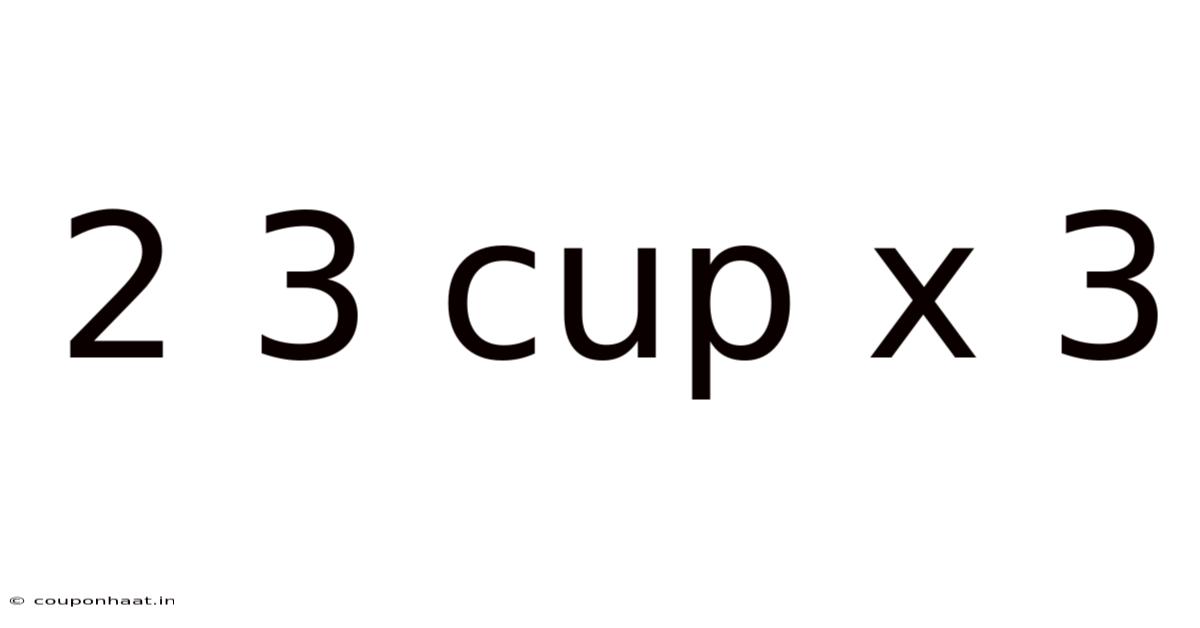
Decoding the Mystery: 2 3-Cup X 3 – A Deep Dive into Measurement, Mathematics, and Real-World Applications
This article looks at the seemingly simple mathematical expression "2 3-cup x 3," exploring its implications across various fields, from basic arithmetic to practical applications in cooking, baking, and even scientific measurements. We'll break down the problem step-by-step, examine its underlying mathematical principles, and discuss its relevance in everyday life. Understanding this seemingly simple equation offers a valuable foundation for stronger mathematical skills and problem-solving abilities Small thing, real impact..
Introduction: Unpacking the Problem
At first glance, "2 3-cup x 3" appears straightforward. This exploration will not only solve the equation but also illuminate the importance of precise measurement and understanding units in various contexts. It's a multiplication problem involving units of measurement. Still, the inclusion of "3-cup" introduces a layer of complexity that requires careful consideration of units and the order of operations. We will also look at how this simple problem can be extrapolated to more complex scenarios And that's really what it comes down to..
Step-by-Step Solution: Breaking Down the Calculation
The key to solving "2 3-cup x 3" lies in understanding that "3-cup" represents a single unit of measurement. We are dealing with a quantity of three cups, and we have two of these quantities. Which means, we can break down the calculation as follows:
-
Identify the units: The problem uses "cups" as the unit of measurement. This is crucial for interpreting the final answer Surprisingly effective..
-
Calculate the initial quantity: We begin with "2 3-cup." This is equivalent to 2 * (3 cups) = 6 cups. We now have a total of six cups.
-
Perform the multiplication: The next step is to multiply the result from step 2 by 3: 6 cups x 3 = 18 cups Simple, but easy to overlook..
That's why, the solution to "2 3-cup x 3" is 18 cups.
Mathematical Principles: Understanding the Fundamentals
This seemingly simple problem highlights several fundamental mathematical principles:
-
Multiplication: The core operation is multiplication, demonstrating the repeated addition of a quantity. Multiplying 6 cups by 3 is the same as adding 6 cups three times (6 + 6 + 6 = 18 cups) Still holds up..
-
Order of Operations (PEMDAS/BODMAS): Although not explicitly shown in this specific problem, understanding the order of operations (Parentheses/Brackets, Exponents/Orders, Multiplication and Division, Addition and Subtraction) is vital for more complex equations involving multiple operations. In this case, the implied parentheses around "3-cup" dictate that this unit must be treated as a single entity before further calculations It's one of those things that adds up. But it adds up..
-
Units of Measurement: The inclusion of "cups" underscores the importance of considering units when performing calculations. Inaccurate unit handling can lead to significant errors, particularly in fields like engineering, physics, and cooking. Here's one way to look at it: confusing cups with liters would produce an entirely different, and incorrect, result Simple as that..
Real-World Applications: Beyond the Textbook
The seemingly simple equation "2 3-cup x 3 = 18 cups" has a wide range of practical applications:
-
Cooking and Baking: Recipes frequently use measurements in cups. Understanding how to manipulate these measurements is essential for scaling recipes up or down. If a recipe calls for 2 batches of a mixture, each containing 3 cups of flour, and you need to triple the recipe, you would need 18 cups of flour (2 * 3 cups * 3 = 18 cups).
-
Science and Experimentation: In scientific experiments, precise measurements are essential. Whether dealing with liquids, solids, or gases, accurately calculating quantities is crucial for reproducibility and reliable results. The principles illustrated by this simple problem apply directly to scaling experiments and maintaining consistent ratios of ingredients.
-
Construction and Engineering: While the units might be different (e.g., cubic meters, gallons, liters), the principles of multiplication and accurate unit handling are crucial for calculations in construction and engineering projects. Scaling up blueprints or calculating material quantities requires a strong grasp of basic arithmetic and units.
-
Everyday Life: From measuring ingredients for a drink to calculating the amount of paint needed for a project, this basic mathematical skill underpins numerous everyday activities. Understanding how to efficiently handle measurements saves time, resources, and reduces potential errors Practical, not theoretical..
Expanding the Concept: More Complex Scenarios
The basic concept of "2 3-cup x 3" can be expanded to more complex scenarios. Consider these examples:
-
Variable Quantities: Instead of fixed values, the quantities could be represented by variables. Here's one way to look at it: if 'x' represents the number of 3-cup batches, then the total would be 3x cups. This introduces the concept of algebraic expressions and equations Still holds up..
-
Multiple Units: The problem could involve multiple units of measurement, such as cups, ounces, or milliliters. This necessitates unit conversion, a fundamental skill in various fields. Take this case: converting cups to milliliters would involve understanding conversion factors and applying them correctly The details matter here. Practical, not theoretical..
-
Fractions and Decimals: The quantities could be expressed as fractions or decimals. Take this: "2.5 3-cup x 3" would require understanding decimal multiplication and maintaining accurate units.
By exploring these more complex scenarios, a deeper understanding of mathematical principles and their applications in practical situations can be achieved Less friction, more output..
Frequently Asked Questions (FAQ)
Q: What if the problem was "3 2-cup x 2"?
A: Following the same steps:
- 3 * 2 cups = 6 cups
- 6 cups * 2 = 12 cups
The answer would be 12 cups Less friction, more output..
Q: How important is understanding units in this calculation?
A: Understanding units is very important. The answer would not be 18, but 18 something. Without correctly identifying and handling the "cups" unit, the calculation would be meaningless. The units provide context and meaning to the numerical result It's one of those things that adds up..
Q: Can this problem be solved using different mathematical methods?
A: While multiplication is the most straightforward method, the problem could also be solved using repeated addition (adding 6 cups three times). This highlights the connection between addition and multiplication.
Q: How can I improve my understanding of measurements and units?
A: Practice is key. Work through various problems involving different units of measurement. Use online resources or textbooks to learn about unit conversion and standard measurement systems (metric and imperial) Not complicated — just consistent. Still holds up..
Conclusion: The Significance of a Simple Equation
The seemingly insignificant equation "2 3-cup x 3" provides a powerful foundation for understanding fundamental mathematical concepts and their relevance to everyday life. So naturally, from simple cooking to complex scientific experiments, mastering the principles of multiplication, order of operations, and unit handling is critical. This exploration showcases that even the most basic mathematical problems offer valuable insights and practical applications, reinforcing the importance of continuous learning and a deeper understanding of the mathematical world around us. By grasping these fundamental concepts, we equip ourselves with essential skills for problem-solving and a more comprehensive understanding of the world. The seemingly simple "18 cups" is much more than just a number; it's a testament to the power of precise calculation and its far-reaching impact across numerous disciplines That alone is useful..
