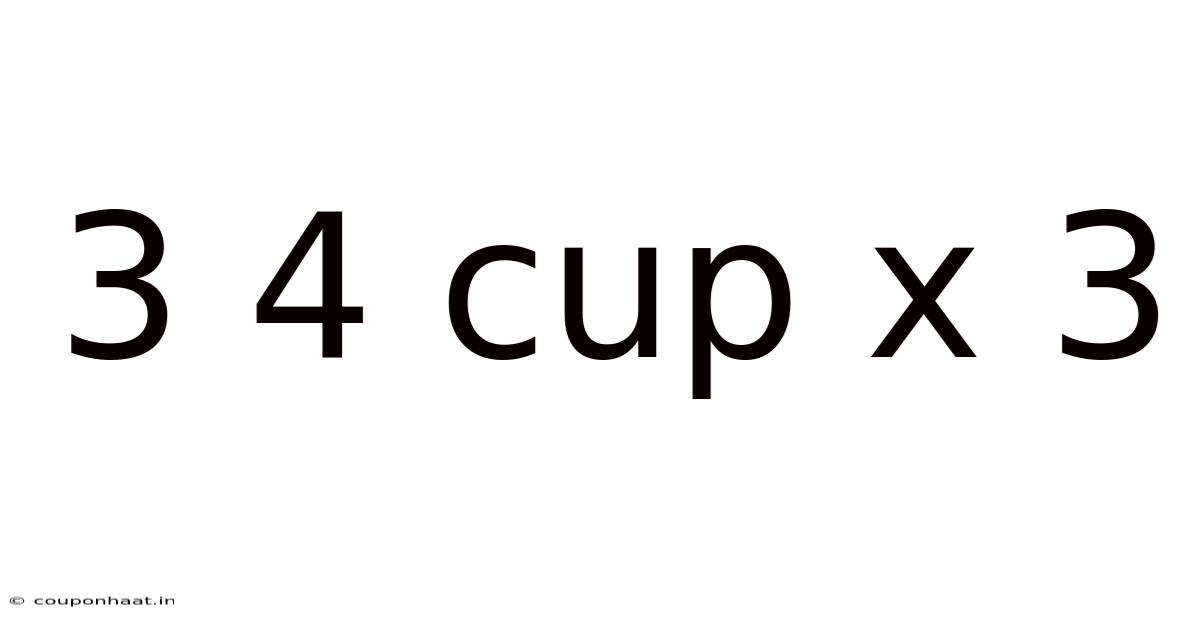
Decoding 3 4-Cup X 3: Understanding Volume, Scaling Recipes, and Culinary Applications
This article gets into the meaning and implications of "3 4-cup x 3," a phrase that commonly arises in cooking, baking, and other fields involving volume measurements. We will explore its mathematical interpretation, practical applications in scaling recipes, potential confusion, and offer solutions for accurate measurement and consistent results. Understanding this seemingly simple phrase unlocks a deeper understanding of volume calculations and precise culinary techniques.
Understanding the Basic Measurement: 3 4-Cup
The phrase begins with "3 4-cup.In practice, " This signifies a volume measurement equivalent to three-quarters of a standard cup. So naturally, a standard US cup holds 8 fluid ounces (approximately 237 milliliters). Because of this, 3/4 cup equals (3/4) * 8 fluid ounces = 6 fluid ounces (approximately 178 milliliters). This is a fundamental unit in many recipes, often used for ingredients like flour, sugar, and liquids.
Most guides skip this. Don't.
Multiplying the Volume: 3 4-Cup x 3
The core of the phrase lies in the multiplication: "3 4-cup x 3". This simplifies to 2 ¼ cups. Mathematically, this is expressed as: (3/4 cup) * 3 = 9/4 cups. Also, this indicates that the initial volume of 3/4 cup is being tripled. Which means, "3 4-cup x 3" equates to 2 ¼ cups or two and a quarter cups.
This changes depending on context. Keep that in mind.
Practical Applications in Cooking and Baking
This calculation is crucial for scaling recipes. Imagine a recipe that calls for 3/4 cup of sugar, but you want to triple the recipe to serve more people. Think about it: understanding "3 4-cup x 3" allows you to quickly calculate the required amount of sugar: 2 ¼ cups. This precise scaling is essential for achieving consistent results That's the part that actually makes a difference..
- Under-baked or over-baked goods: In baking, precise ratios of ingredients are critical. Incorrect scaling can result in dense cakes, crumbly cookies, or flat pastries.
- Off-flavors: In some recipes, altering ingredient proportions can drastically alter the taste. Here's a good example: too much sugar can make a dish overly sweet, while too little can leave it bland.
- Inconsistent textures: Similar to baking, incorrect scaling in savory dishes can impact texture. A sauce might be too thin or too thick, a stew too watery or too dry.
Beyond the Kitchen: Applications in Other Fields
While most commonly associated with cooking, the concept of "3 4-cup x 3" and similar calculations has broader applications. In fields like:
- Chemistry: Scientists frequently scale down or up experimental procedures, involving precise volume calculations of reagents.
- Pharmacology: Accurate dosage calculations are crucial in the pharmaceutical industry, using similar multiplicative principles to ensure correct medicine administration.
- Construction: Calculating material quantities for projects often involves scaling up from smaller units to larger volumes.
Common Misunderstandings and How to Avoid Them
One frequent source of error is confusing 3/4 cup with 3 cups. Remembering that "3 4-cup" signifies three-quarters of a single cup, and not three separate cups, is crucial. Clearly writing out the fractional measurement helps prevent misinterpretations Simple as that..
Accurate Measurement Techniques: Avoiding Errors
Accurate measurement is key when scaling recipes. Here are some tips for achieving precise results:
- Use measuring cups designed for dry and liquid ingredients: Dry measuring cups are typically used for flour, sugar, and other dry ingredients. Liquid measuring cups, with their clear markings, are essential for measuring liquids accurately. Using the wrong type of measuring cup can lead to significant errors.
- Level off dry ingredients: Avoid packing down dry ingredients into the measuring cup; instead, use a straight edge to level them off at the top. Packing down can introduce significant extra volume.
- Read liquid measurements at eye level: Ensure the measuring cup is placed on a flat surface, and read the measurement at eye level to avoid parallax error.
- Use a kitchen scale: For the most precise measurements, particularly for baking, using a kitchen scale can dramatically improve accuracy. Weighing ingredients eliminates variations caused by variations in packing or leveling of ingredients.
Frequently Asked Questions (FAQ)
Q: Can I use a different unit of measurement besides cups?
A: Yes, you can. The principle remains the same regardless of the unit used (milliliters, liters, fluid ounces, etc.). You would simply perform the equivalent calculation using the chosen unit. To give you an idea, if you know that 3/4 of a cup is approximately 178ml, then 3/4 cup x 3 would be 178ml x 3 = 534ml That alone is useful..
Q: What if I don't have the exact measuring cup size needed?
A: If you lack the precise measuring tool (e.On the flip side, g. , a 1/4 cup measuring cup), you can use smaller measuring cups and combine them. Here's a good example: you can achieve 2 ¼ cups by using two 1-cup measuring cups and one 1/4 cup measuring cup.
Q: How crucial is precise measurement when scaling recipes?
A: The importance of precise measurement varies depending on the recipe. Baking recipes often require more precise measurements than cooking recipes. That said, in all cases, aiming for accuracy will improve consistency and results.
Conclusion: Mastering Volume and Scaling for Culinary Success
Understanding the meaning and application of "3 4-cup x 3" is a fundamental skill for anyone who enjoys cooking or baking. The ability to accurately scale recipes empowers culinary creativity and allows for consistent, predictable results. Even so, by mastering these simple mathematical concepts and employing accurate measurement techniques, you can confidently adapt recipes to suit your needs and achieve culinary success. Remember that precision is key, and taking the time to measure accurately will significantly impact the quality of your final product. Which means from mastering simple baking tasks to tackling more complex culinary endeavors, accurate volume calculations serve as a foundation for success. Day to day, the ability to confidently scale recipes ensures consistent results, enhancing your enjoyment and expertise in the culinary arts. Don't be intimidated by the numbers – embrace the process and celebrate the delicious outcome!
