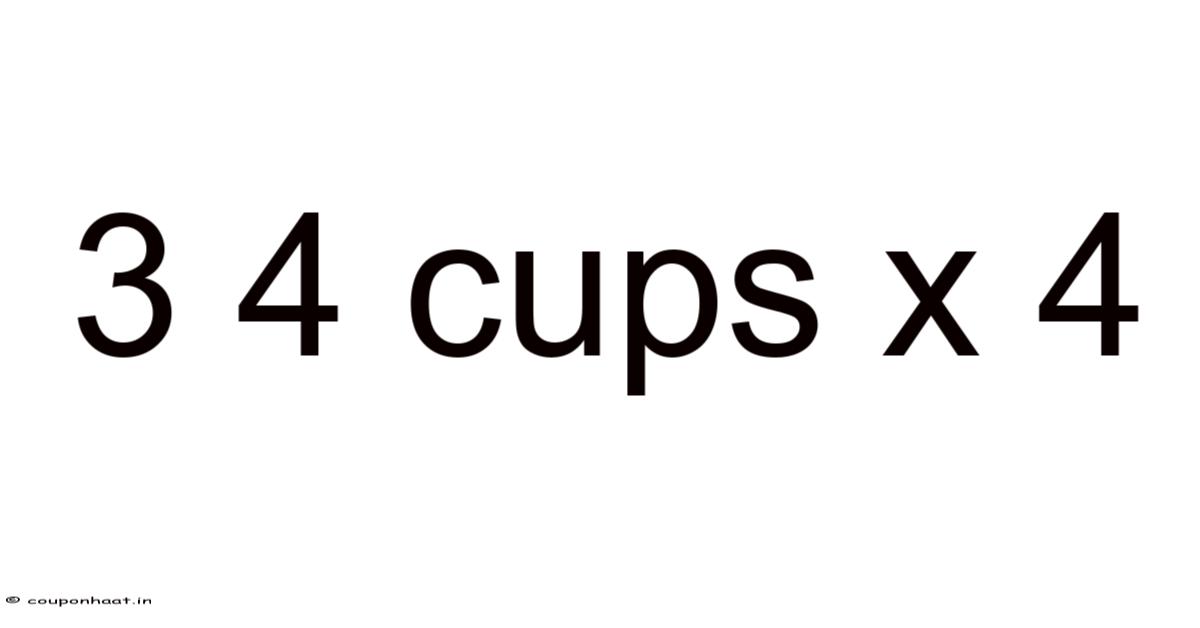
Decoding the Mystery: Exploring the Mathematical and Practical Implications of "3 4 Cups x 4"
This seemingly simple phrase, "3 4 cups x 4," hides a surprising depth of mathematical and practical considerations. It's a question that can be tackled from several angles, from basic arithmetic to advanced concepts of measurement and scaling in various contexts, such as cooking, crafting, and even scientific experiments. This article will walk through the multiple interpretations and solutions, clarifying any ambiguity and highlighting the importance of precise measurement in diverse fields. Understanding this seemingly simple problem unlocks a broader understanding of fundamental mathematical principles and their real-world applications Most people skip this — try not to. No workaround needed..
Understanding the Core Problem: 3 4 Cups Multiplied by 4
At its most basic level, "3 4 cups x 4" presents a multiplication problem involving a mixed fraction. Let's break it down:
-
3 4 cups: This represents a quantity of three and four-quarters cups. It's a mixed fraction, combining a whole number (3) and a fraction (4/4, which simplifies to 1). Because of this, 3 4 cups is equivalent to 3 + 1 = 4 cups Still holds up..
-
x 4: This signifies multiplication by a factor of 4.
So, the core problem is: 4 cups x 4 = ?
The straightforward mathematical answer is: 16 cups.
Mathematical Approaches and Solutions
While the above solution is straightforward, let's explore more nuanced mathematical approaches that enhance understanding and adaptability to similar problems:
1. Converting to Improper Fractions: A common method for solving multiplication problems with mixed fractions involves converting them into improper fractions.
-
Convert 3 4 cups to an improper fraction: (3 x 4) + 4 = 16/4 cups
-
Perform the multiplication: (16/4) x 4 = 64/4 cups
-
Simplify the improper fraction: 64/4 = 16 cups. This confirms our initial solution Not complicated — just consistent..
This method is crucial for more complex problems involving multiplication and division of mixed fractions. It solidifies the understanding of fractional arithmetic.
2. Distributive Property: Another valuable mathematical approach utilizes the distributive property. This involves separating the mixed fraction into its whole number and fractional components before multiplying The details matter here. That alone is useful..
-
Separate the mixed fraction: 3 4 cups can be written as 3 cups + 1 cup (since 4/4 = 1)
-
Apply the distributive property: (3 cups + 1 cup) x 4 = (3 cups x 4) + (1 cup x 4) = 12 cups + 4 cups = 16 cups
This method illustrates the flexibility and power of algebraic manipulation, demonstrating how different approaches lead to the same correct answer The details matter here..
Practical Applications: Beyond the Numbers
The seemingly simple calculation of "3 4 cups x 4" has far-reaching practical applications across numerous disciplines:
1. Cooking and Baking: In culinary arts, precise measurement is very important. Recipes often require specific quantities of ingredients. Scaling a recipe up or down necessitates a solid grasp of multiplication and conversion of units. If a recipe calls for 3 4 cups of flour, and you need to quadruple the recipe, understanding the calculation to arrive at 16 cups of flour is essential for a successful outcome. This applies to all ingredients, ensuring consistency and quality Less friction, more output..
2. Crafting and DIY Projects: Many crafting projects, from knitting and crocheting to woodworking and pottery, require precise measurements. Understanding the multiplication of fractional units allows for accurate scaling of patterns and materials. To give you an idea, a project that requires 3 4 yards of fabric, multiplied by 4 to create multiple items, would necessitate 16 yards of fabric.
3. Science and Engineering: Precise measurement is foundational in scientific experiments and engineering projects. Whether it involves measuring chemicals, liquids, or other materials, accurate calculations are crucial for reproducibility and reliability of results. Scaling experiments or designing larger-scale prototypes often involves multiplying fractional units, requiring an understanding of the principles covered here.
4. Construction and Building: In construction and building projects, accurate measurements are critical for safety and structural integrity. Scaling plans and quantities of materials requires a strong grasp of measurement and mathematical calculation. Using "3 4" units might represent fractional parts of a building material, for instance, and understanding how that scales with larger projects is key.
Addressing Potential Ambiguities and Variations
While the interpretation of "3 4 cups x 4" is relatively straightforward, it's crucial to acknowledge potential ambiguities that might arise in different contexts:
-
Typographical Errors: The phrase might represent a typographical error. It is possible that the intended meaning was 3/4 cup x 4, which would yield a significantly different answer (3 cups). Context is key in clarifying this ambiguity.
-
Measurement Systems: make sure to note that the units are expressed in "cups." While "cups" are a relatively common unit of measurement, understanding different measurement systems (like metric) and conversions is vital for diverse applications.
Frequently Asked Questions (FAQ)
Q: What if the problem was 3 ¾ cups x 4?
A: This introduces a slightly different calculation. Because of that, first, convert 3 ¾ cups to an improper fraction: (3 x 4 + 3) / 4 = 15/4 cups. Then, multiply by 4: (15/4) x 4 = 15 cups. The presence of the ¾ changes the final answer.
Q: How can I apply these calculations to other units of measurement?
A: The same principles apply to any unit of measurement. Whether it's liters, meters, grams, or other units, converting mixed fractions to improper fractions and applying the distributive property will lead to accurate solutions. Ensure consistency in units throughout the calculation Not complicated — just consistent. Surprisingly effective..
Q: What are some common mistakes to avoid when dealing with fractional units?
A: Common mistakes include incorrect conversion of mixed fractions to improper fractions, misapplication of the distributive property, and neglecting to maintain unit consistency throughout the calculation. Double-checking your work and using multiple approaches can help minimize errors Still holds up..
Conclusion: The Power of Precision
The seemingly simple calculation of "3 4 cups x 4" reveals a deeper understanding of mathematical principles and their wide-ranging applications. From the basic arithmetic of multiplying mixed fractions to the practical implications in cooking, crafting, science, and engineering, mastering these concepts is essential for accuracy and success in various endeavors. By converting mixed fractions to improper fractions, using the distributive property, and carefully considering the context, we can manage the complexities of these calculations with confidence and precision. The emphasis on accuracy underscores the importance of attention to detail in all aspects of life, where precise measurements can make a world of difference.
