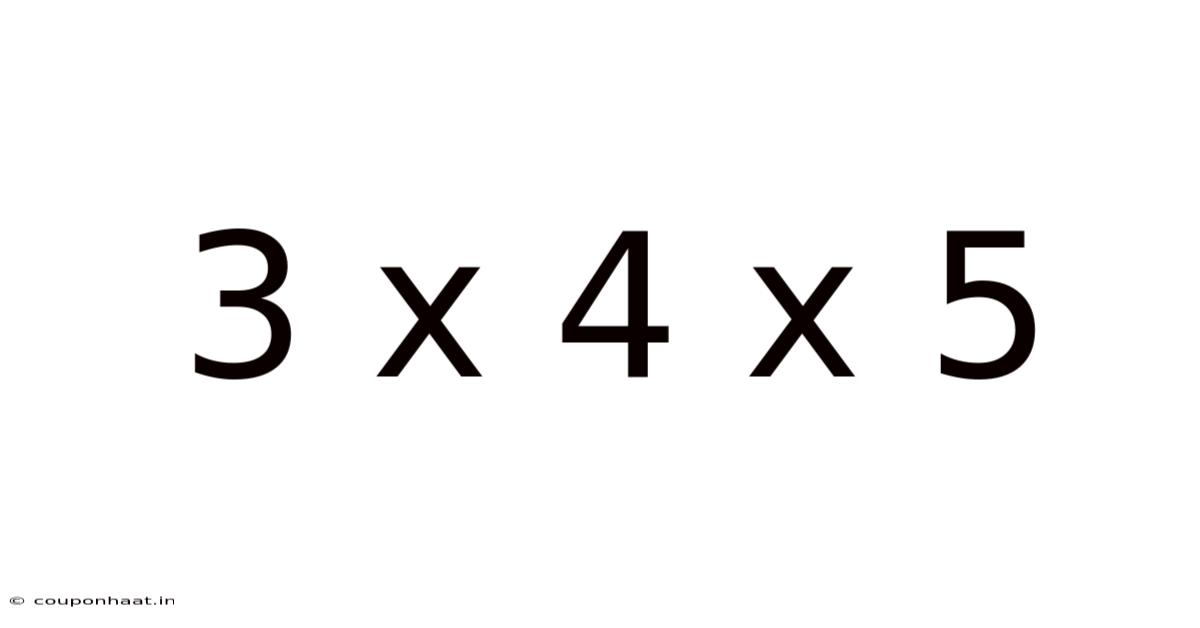
Unveiling the Mysteries of 3 x 4 x 5: A Deep Dive into Multiplication and Beyond
This article explores the seemingly simple equation 3 x 4 x 5, delving far beyond the immediate answer of 60. We'll examine its mathematical implications, explore real-world applications, and uncover the fascinating connections to broader mathematical concepts. This exploration is perfect for anyone seeking a deeper understanding of multiplication, its properties, and its significance in various fields. Understanding the fundamentals of 3 x 4 x 5 provides a solid foundation for more complex mathematical concepts.
Introduction: More Than Just a Number
At first glance, 3 x 4 x 5 = 60 might seem trivial. Still, this seemingly simple equation serves as a gateway to understanding fundamental mathematical principles. It showcases the power of multiplication, a core operation in arithmetic, and opens the door to exploring concepts such as factors, multiples, prime factorization, and even geometry. This exploration will show you how a simple equation can tap into a wealth of mathematical understanding And it works..
Understanding the Fundamentals: Multiplication and its Properties
Multiplication is essentially repeated addition. So 3 x 4, for instance, means adding 3 four times (3 + 3 + 3 + 3 = 12). Expanding this to 3 x 4 x 5 means taking the result of 3 x 4 (which is 12) and adding it five times (12 + 12 + 12 + 12 + 12 = 60) Small thing, real impact..
Multiplication possesses several key properties:
-
Commutative Property: The order of the numbers doesn't matter. 3 x 4 x 5 = 5 x 3 x 4 = 4 x 5 x 3 = 60. This property allows for flexibility in calculations Worth knowing..
-
Associative Property: You can group the numbers differently without changing the result. (3 x 4) x 5 = 3 x (4 x 5) = 60. This simplifies complex calculations.
-
Distributive Property: This property links multiplication and addition. Take this: 3 x (4 + 5) = (3 x 4) + (3 x 5) = 12 + 15 = 27. This is crucial for simplifying expressions.
-
Identity Property: Multiplying any number by 1 results in the same number. 1 x 3 x 4 x 5 = 60.
Understanding these properties is essential for efficient calculation and solving more complex mathematical problems. The simplicity of 3 x 4 x 5 allows us to clearly see these properties in action Practical, not theoretical..
Factors and Multiples: Unveiling the Relationships
The numbers 3, 4, and 5 are factors of 60. Also, this means they divide evenly into 60 without leaving a remainder. Because of that, conversely, 60 is a multiple of 3, 4, and 5. This simple relationship forms the foundation of number theory No workaround needed..
Let's explore the factors of 60: 1, 2, 3, 4, 5, 6, 10, 12, 15, 20, 30, and 60. Each of these numbers divides evenly into 60. Understanding factors and multiples is crucial for simplifying fractions, solving equations, and understanding divisibility rules.
Prime Factorization: Breaking Down the Numbers
Prime factorization is the process of expressing a number as a product of its prime factors. A prime number is a whole number greater than 1 that has only two divisors: 1 and itself. But the prime factorization of 60 is 2² x 3 x 5. This means 60 can be expressed as 2 x 2 x 3 x 5.
Prime factorization is a fundamental concept in number theory and has applications in cryptography and other advanced mathematical fields. Analyzing the prime factorization of 60 from the original equation (3 x 4 x 5) highlights the building blocks of the number Small thing, real impact..
Real-World Applications: From Geometry to Everyday Life
The equation 3 x 4 x 5 has practical applications in various real-world scenarios:
-
Geometry: Imagine a rectangular prism (a box) with dimensions 3 units, 4 units, and 5 units. The volume of this prism is calculated by multiplying these dimensions: 3 x 4 x 5 = 60 cubic units. This demonstrates the direct application of multiplication in three-dimensional geometry.
-
Counting Objects: If you have 3 boxes, each containing 4 bags, and each bag holds 5 apples, you have a total of 3 x 4 x 5 = 60 apples. This illustrates the use of multiplication in everyday counting problems.
-
Measurement Conversions: Multiplication has a real impact in converting units of measurement. Here's one way to look at it: if you need to calculate the total area of 3 rectangular plots of land, each measuring 4 meters by 5 meters, the total area is 3 x (4m x 5m) = 60 square meters Simple, but easy to overlook..
-
Finance: In scenarios involving interest calculations or compound growth, multiplication is often employed to determine the total amount after a period.
These examples highlight the ubiquitous nature of multiplication and how the simple equation 3 x 4 x 5 translates into tangible results It's one of those things that adds up..
Exploring Higher Dimensions: Extending the Concept
The concept of 3 x 4 x 5 can be extended to higher dimensions. Imagine a hypercube (a four-dimensional cube). If each side of this hypercube has a length of 3 units, the “hypervolume” would involve a multiplication of four 3s (3 x 3 x 3 x 3 = 81). This showcases how the principle of multiplication extends into abstract mathematical concepts.
Advanced Mathematical Concepts: A Glimpse into the Future
The seemingly simple equation 3 x 4 x 5 touches upon more advanced mathematical concepts:
-
Modular Arithmetic: Exploring the remainders when 60 is divided by different numbers introduces modular arithmetic, a crucial part of cryptography and computer science.
-
Number Theory: This equation provides a foundation for understanding divisibility rules, prime numbers, and other core concepts in number theory.
-
Abstract Algebra: The properties of multiplication (commutative, associative) are foundational concepts in abstract algebra, which studies algebraic structures beyond the usual numbers Took long enough..
These advanced applications demonstrate the surprising depth and far-reaching implications of such a simple equation.
Frequently Asked Questions (FAQs)
Q: What is the simplest way to calculate 3 x 4 x 5?
A: The most straightforward method is to perform the multiplication step-by-step: 3 x 4 = 12, then 12 x 5 = 60. You can also rearrange the numbers using the commutative property for easier calculation.
Q: Are there other ways to arrive at the answer 60 besides 3 x 4 x 5?
A: Yes, many combinations of numbers can multiply to 60. Take this: 6 x 10, 12 x 5, 15 x 4, 2 x 3 x 10, and many more. The prime factorization (2² x 3 x 5) provides the fundamental building blocks Less friction, more output..
Q: What if one of the numbers was negative?
A: If one of the numbers (3, 4, or 5) were negative, the result would be negative. To give you an idea, 3 x 4 x (-5) = -60. The rules of multiplying positive and negative numbers would apply Easy to understand, harder to ignore..
Q: How does this relate to other mathematical operations?
A: Multiplication is closely related to addition (repeated addition), subtraction (the inverse of addition), and division (the inverse of multiplication). Understanding the relationships between these operations is crucial for mastering arithmetic Surprisingly effective..
Conclusion: The Significance of Simple Equations
The exploration of 3 x 4 x 5 has unveiled more than just a simple calculation. From basic geometry to advanced number theory, this seemingly simple equation holds significant weight and provides a solid foundation for understanding more complex mathematical ideas. It's a journey into the fundamental principles of arithmetic, showcasing the power of multiplication and its connections to various mathematical concepts. Because of that, the journey from a simple equation to a deeper understanding of mathematical principles is a testament to the richness and interconnectedness of mathematics. This seemingly straightforward calculation opens doors to a fascinating and expansive world of mathematical exploration.
Not the most exciting part, but easily the most useful.
