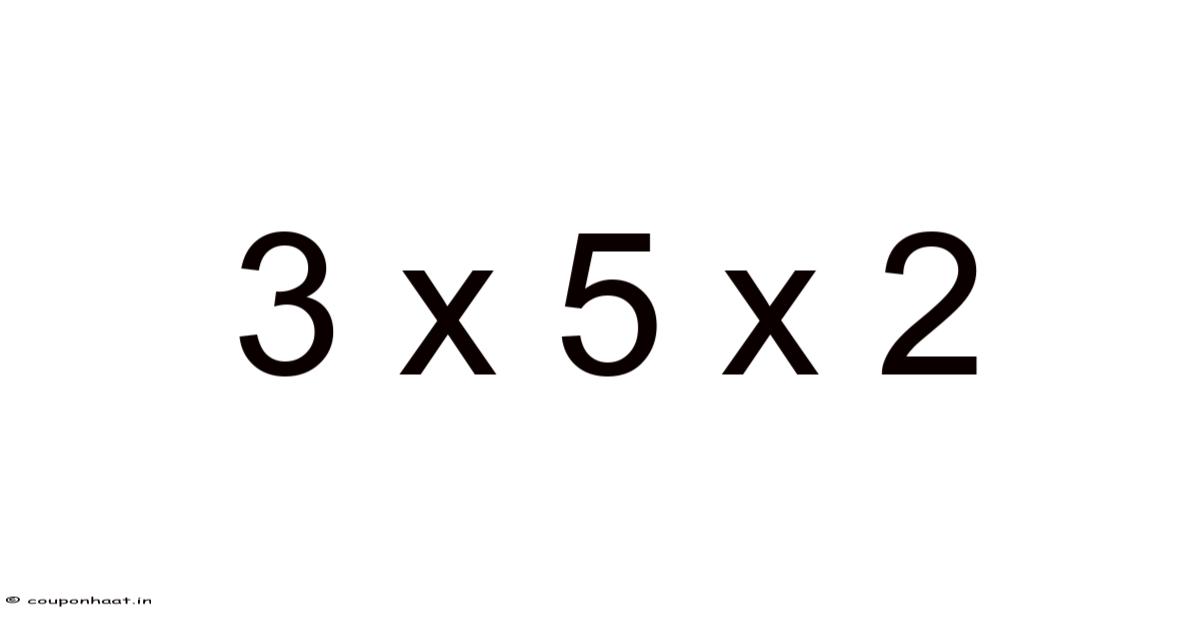
Decoding 3 x 5 x 2: Exploring Dimensions, Volume, and Applications
This seemingly simple expression, "3 x 5 x 2," immediately evokes the idea of dimensions and volume. But its significance goes far beyond a basic multiplication problem. It serves as a foundational concept in various fields, from elementary mathematics and geometry to advanced engineering and design. In practice, this article will look at the multifaceted implications of 3 x 5 x 2, exploring its geometrical interpretation, calculating its volume, examining real-world applications, and addressing frequently asked questions. Understanding this seemingly simple equation opens doors to a deeper understanding of spatial reasoning and problem-solving.
Worth pausing on this one.
Understanding the Dimensions
The expression "3 x 5 x 2" represents three dimensions: length, width, and height. We can visualize this as a rectangular prism (or cuboid).
- Length: This is typically the longest dimension. In our case, we can consider it to be 5 units.
- Width: This is the shorter dimension, perpendicular to the length. Here, it is 3 units.
- Height: The vertical dimension, perpendicular to both length and width. In this example, the height is 2 units.
These units could represent any measurement: centimeters, meters, inches, feet, etc. The critical aspect is the ratio between the dimensions, which remains constant regardless of the unit of measurement No workaround needed..
The order of these dimensions is not strictly fixed, as long as we maintain consistency in labeling. So naturally, it could be presented as 2 x 3 x 5 or 5 x 2 x 3, and the resulting volume would remain the same. On the flip side, clarifying the orientation helps in visualization and practical applications.
Calculating the Volume
The volume of a rectangular prism is calculated by multiplying its length, width, and height. So, the volume of a rectangular prism with dimensions 3 x 5 x 2 is:
Volume = Length x Width x Height = 5 x 3 x 2 = 30 cubic units
Again, the "cubic units" depend on the original unit of measurement. If the dimensions are in centimeters, the volume is 30 cubic centimeters (cm³). Even so, if they are in inches, the volume is 30 cubic inches (in³), and so on. The cubic unit signifies that we are measuring a three-dimensional space.
This calculation is fundamental to various applications, including:
- Packaging and Shipping: Determining the volume of a package is crucial for calculating shipping costs and ensuring efficient packing.
- Construction and Engineering: Calculating volumes of materials like concrete, soil, or water is essential for planning and budgeting in construction projects.
- Manufacturing: Understanding volumes is critical in designing containers, molds, and other components.
Real-World Applications: Beyond the Textbook
The concept of 3 x 5 x 2 extends beyond simple mathematical exercises. Let's explore some real-world examples:
1. Storage and Organization: Imagine organizing a closet. If the closet measures 3 feet wide, 5 feet long, and 2 feet deep, its volume is 30 cubic feet. This allows you to estimate how much storage space is available and how many items you can fit inside And that's really what it comes down to..
2. Aquariums and Fish Tanks: A rectangular aquarium with dimensions of 30 cm x 50 cm x 20 cm has a volume of 30,000 cubic centimeters or 30 liters. This helps determine the appropriate water volume and the number of fish that can be comfortably housed Which is the point..
3. Concrete Slabs: In construction, calculating the volume of a concrete slab is crucial for ordering the correct amount of material. A slab measuring 3 meters x 5 meters x 0.2 meters (20 centimeters thick) would require 3 cubic meters of concrete.
4. Gardening and Landscaping: The volume of soil needed for a raised garden bed can be calculated using similar principles. A bed measuring 3 feet x 5 feet x 2 feet requires 30 cubic feet of soil.
Exploring Variations and Scalability
The beauty of the 3 x 5 x 2 model lies in its scalability. We can easily adjust the dimensions to suit different needs. For example:
- Doubling the dimensions: If we double each dimension (6 x 10 x 4), the volume increases eightfold (240 cubic units). This demonstrates the cubic relationship between dimensions and volume.
- Halving the dimensions: Halving each dimension (1.5 x 2.5 x 1) results in an eightfold decrease in volume (3.75 cubic units).
- Changing a single dimension: Altering just one dimension proportionally changes the volume. Here's one way to look at it: increasing the length to 10 while keeping the width and height constant (10 x 3 x 2) results in a volume of 60 cubic units, doubling the original volume.
This scalability is critical in design and engineering, allowing for adjustments based on specific requirements and constraints.
Further Mathematical Explorations
The concept of 3 x 5 x 2 can be further explored through more advanced mathematical concepts:
- Surface Area: Calculating the surface area of the rectangular prism (adding the areas of all six faces) provides valuable information for painting, covering, or wrapping the object.
- Diagonal Length: Using the Pythagorean theorem in three dimensions, we can calculate the length of the space diagonal of the prism, which connects opposite corners.
- Scaling and Proportionality: Exploring the relationship between changes in dimensions and the resulting changes in volume and surface area highlights fundamental principles of scaling and proportionality.
Frequently Asked Questions (FAQ)
Q: What if the dimensions are not whole numbers?
A: The calculation remains the same. You simply multiply the decimal values to obtain the volume. Here's one way to look at it: a prism with dimensions 2.Plus, 5 x 4 x 1. 5 would have a volume of 15 cubic units.
Q: How do I convert cubic units to other units?
A: You need conversion factors. Take this: to convert cubic centimeters (cm³) to liters, you would use the conversion factor 1 liter = 1000 cm³ Not complicated — just consistent..
Q: Can this concept be applied to objects that are not rectangular prisms?
A: No, directly. Even so, this formula applies specifically to rectangular prisms. Other shapes require different volume calculation methods, often involving more complex geometrical formulas.
Q: What are some real-world limitations of this simple calculation?
A: In reality, materials may not be perfectly rectangular, leading to slight variations in volume. Irregularities or imperfections in materials should be considered for precise estimations.
Conclusion
The seemingly simple equation, 3 x 5 x 2, embodies a powerful concept with far-reaching implications. It is a cornerstone of spatial reasoning, providing the foundation for understanding volume, and finding practical applications in various fields. By grasping the basic principles of volume calculation and dimensional analysis, we reach the ability to approach complex problems in a more insightful and effective way. This leads to from organizing a closet to designing a building, this fundamental concept plays a vital role in our everyday lives and professional endeavors. Understanding 3 x 5 x 2 is not merely about calculating a number; it's about developing a fundamental understanding of space and its measurement.
