Decoding the Mystery: A Deep Dive into CH3CH2CH2CH2OH (Butanol)
Introduction
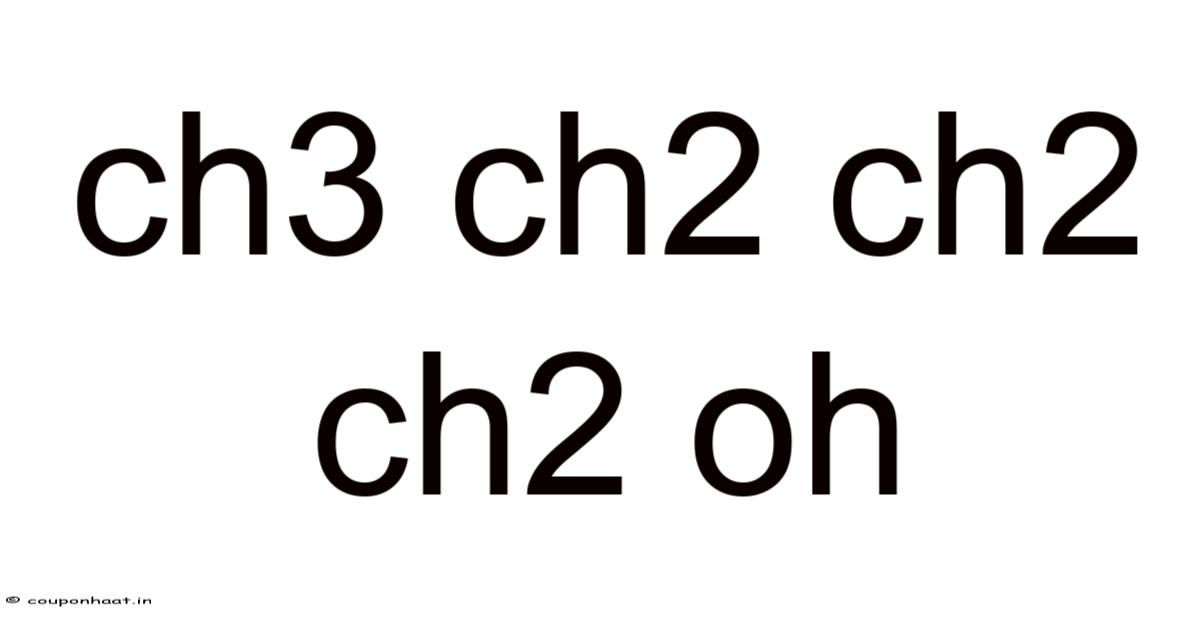
The chemical formula CH3CH2CH2CH2OH represents n-butanol, often simply called butanol. Understanding its structure, properties, production, and applications is crucial for anyone interested in organic chemistry, chemical engineering, or even the broader field of materials science. This comprehensive article will explore all aspects of this important compound, explaining its characteristics in a clear and accessible manner, suitable for both students and enthusiasts. Which means we'll break down its structural features, discuss its various isomers, examine its production methods, and highlight its wide-ranging applications across various industries. By the end, you’ll have a thorough understanding of this seemingly simple yet remarkably versatile molecule Turns out it matters..
Understanding the Structure of CH3CH2CH2CH2OH
The formula CH3CH2CH2CH2OH reveals a straightforward linear structure. Let's break it down:
- CH3: This represents a methyl group, a carbon atom bonded to three hydrogen atoms.
- CH2: This represents a methylene group, a carbon atom bonded to two hydrogen atoms. There are three methylene groups in n-butanol.
- OH: This is a hydroxyl group, characteristic of alcohols. The presence of this hydroxyl group is what classifies n-butanol as an alcohol.
The linear arrangement of the carbon atoms distinguishes n-butanol from its isomers. Worth adding: the carbon atoms form a chain, with the hydroxyl group attached to the terminal carbon atom. This specific arrangement leads to unique physical and chemical properties.
Butanol's Isomers: Exploring the Variations
While CH3CH2CH2CH2OH represents n-butanol (or 1-butanol), butanol also exists in three other isomeric forms:
- Isobutanol (2-methyl-1-propanol): The hydroxyl group remains on a terminal carbon, but a methyl group branches off the second carbon. Its formula is (CH3)2CHCH2OH.
- Sec-butanol (2-butanol): The hydroxyl group is attached to the second carbon atom in a four-carbon chain. Its formula is CH3CH(OH)CH2CH3.
- tert-Butanol (2-methyl-2-propanol): The hydroxyl group is attached to a carbon atom bonded to three other carbon atoms (a tertiary carbon). Its formula is (CH3)3COH.
These isomers exhibit different properties due to their varying structural arrangements. Here's the thing — for example, their boiling points and solubilities in water differ significantly. Understanding these differences is crucial in selecting the appropriate isomer for specific applications It's one of those things that adds up..
Production Methods: From Natural Sources to Synthetic Routes
n-Butanol, and its isomers, can be produced through several methods:
1. Fermentation: This is a traditional and increasingly important bio-based method. Certain microorganisms, such as Clostridium acetobutylicum, can ferment sugars or other carbohydrates to produce butanol as a byproduct. This process offers a sustainable alternative to petroleum-based production. The process involves several steps: cultivation of the microorganism, fermentation of the substrate, and then separation and purification of the butanol. Optimization of these steps is crucial for efficient production.
2. Petrochemical Synthesis: This is a more traditional method involving the hydration of butenes, which are obtained from the cracking of petroleum. This process is highly energy-intensive and reliant on fossil fuels. Still, it remains a significant source of butanol due to its established infrastructure and economies of scale. Several refining processes can be used to generate butenes, followed by hydration to produce butanol. The precise method utilized varies depending on the specific refinery and its feedstock.
3. Repurposing Biomass: Another approach utilizes biomass as a renewable source. Cellulosic biomass, such as agricultural waste or dedicated energy crops, can be converted into butanol using various processes, including gasification and fermentation. Research continues to improve the efficiency and cost-effectiveness of these bio-based methods Still holds up..
Physical and Chemical Properties: A Closer Look
n-Butanol shares some common properties with other alcohols, but its unique structural arrangement influences its specific characteristics:
- Appearance: A clear, colorless liquid.
- Odor: Characteristic pungent, alcoholic odor.
- Boiling Point: Relatively high boiling point (117.7 °C) due to hydrogen bonding between hydroxyl groups.
- Solubility: Partially soluble in water, due to the hydroxyl group’s ability to form hydrogen bonds with water molecules. It's highly soluble in many organic solvents.
- Flammability: n-Butanol is highly flammable, requiring careful handling and storage.
Its chemical reactivity is largely governed by the hydroxyl group. It can undergo typical alcohol reactions, including esterification, dehydration, and oxidation. These reactions provide pathways to synthesize various other chemicals and materials Simple, but easy to overlook..
Applications of Butanol: A Versatile Compound
The diverse applications of n-butanol stem from its unique blend of properties:
1. Solvent: n-Butanol is a widely used industrial solvent in paints, lacquers, varnishes, and other coatings. Its ability to dissolve various resins and polymers, while also being relatively safe and biodegradable, makes it attractive for these applications. The high boiling point allows for slower evaporation, facilitating film formation in coatings Most people skip this — try not to..
2. Intermediate in Chemical Synthesis: n-Butanol serves as an essential building block for the synthesis of many other chemicals, including esters, ethers, and butyl acetates which are used widely in different industries. Its versatility in reactions enables its use in the production of a wide range of value-added products.
3. Fuel Additive: n-Butanol is being explored as a potential biofuel, either as a direct replacement for gasoline or as a blend component. It offers several advantages over ethanol: higher energy density, better compatibility with existing engine technology, and lower hygroscopicity (less water absorption). Research focuses on improving its production efficiency and cost-effectiveness to make it a competitive biofuel.
4. Pharmaceuticals: n-Butanol finds use in certain pharmaceutical formulations as a solvent or excipient. Its ability to dissolve various compounds while being relatively non-toxic makes it suitable for these applications. Even so, stringent purity and safety standards must be met Nothing fancy..
5. Cosmetics and Personal Care: n-Butanol can be found in some cosmetics and personal care products as a solvent or carrier. Similar to its pharmaceutical applications, it’s used due to its relative safety and solvency properties.
Safety and Handling: Important Precautions
When working with n-butanol, it is crucial to observe proper safety precautions:
- Flammability: n-Butanol is highly flammable and should be kept away from ignition sources.
- Inhalation: Inhaling n-butanol vapor can cause irritation to the respiratory tract. Adequate ventilation is necessary.
- Skin Contact: Prolonged or repeated skin contact can cause irritation and dryness. Protective gloves and clothing are recommended.
- Eye Contact: Contact with eyes can cause irritation. Immediate flushing with water is essential.
- Ingestion: Ingestion can cause serious health problems. Immediate medical attention is required.
Frequently Asked Questions (FAQ)
Q: What is the difference between n-butanol and isobutanol?
A: n-Butanol has a linear structure, while isobutanol has a branched structure. This difference in structure leads to variations in their physical and chemical properties, such as boiling points and reactivity The details matter here..
Q: Is butanol toxic?
A: Butanol has a relatively low toxicity compared to many other solvents. Even so, exposure to high concentrations can cause health problems. Proper safety precautions are essential when handling butanol.
Q: What are the environmental impacts of butanol production?
A: The environmental impact depends on the production method. But bio-based production offers a more sustainable alternative, reducing the carbon footprint and reliance on fossil fuels. Petroleum-based production contributes to greenhouse gas emissions and relies on non-renewable resources. Even so, the efficiency and sustainability of bio-based production processes vary considerably and are subject to ongoing research and development.
Q: What are the future prospects for butanol as a biofuel?
A: Butanol has significant potential as a biofuel due to its superior properties compared to ethanol. Ongoing research focuses on improving the efficiency and cost-effectiveness of bio-based butanol production to make it a viable and competitive alternative to fossil fuels. Overcoming challenges in scalability and cost remain crucial for widespread adoption Not complicated — just consistent..
Conclusion
CH3CH2CH2CH2OH, n-butanol, is a seemingly simple molecule with a remarkably diverse range of applications. But its unique combination of physical and chemical properties, coupled with its accessibility through both petrochemical and bio-based routes, makes it a vital chemical in various industries. From its role as a solvent and intermediate in chemical synthesis to its potential as a biofuel, n-butanol plays a significant role in modern society. As research continues to explore new production methods and applications, the importance of this versatile compound is likely to grow further. Understanding its structure, properties, and production methods is critical for anyone working in the fields of chemistry, chemical engineering, or related areas. The ongoing exploration of sustainable production methods offers a promising avenue for a greener and more sustainable future.
