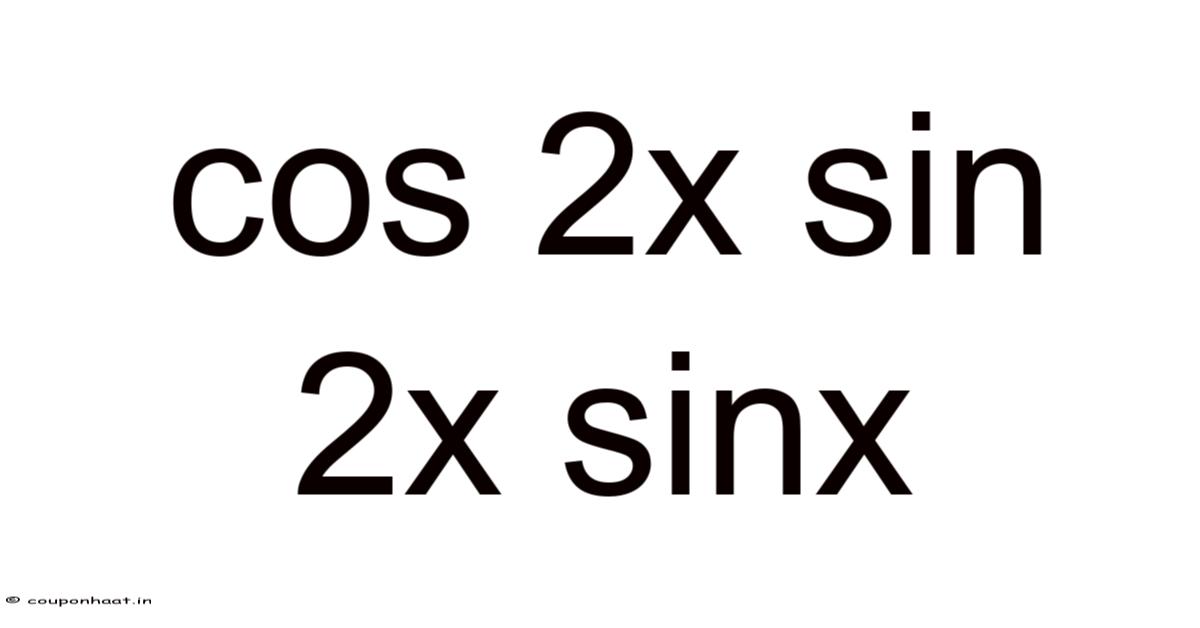
Decoding the Trigonometric Expression: cos(2x)sin(2x)sin(x)
Understanding trigonometric identities and expressions is crucial for anyone studying mathematics, particularly calculus, physics, and engineering. Now, this article delves deep into the trigonometric expression cos(2x)sin(2x)sin(x), exploring its simplification, potential applications, and providing a comprehensive understanding of the underlying principles. We will break down the expression step-by-step, offering various methods for simplification and highlighting the importance of trigonometric identities in achieving this. This exploration will go beyond basic simplification, touching upon the graphical representation and practical implications of such expressions That alone is useful..
No fluff here — just what actually works Most people skip this — try not to..
Introduction: Unveiling the Complexity
At first glance, cos(2x)sin(2x)sin(x) might seem daunting. We’ll explore multiple avenues for simplification, focusing on the most efficient and insightful methods. That said, with a systematic approach and a strong understanding of fundamental trigonometric identities, we can simplify this expression considerably. This article serves as a full breakdown, suitable for students of varying mathematical backgrounds, to fully grasp the simplification process and the underlying trigonometric concepts. By the end of this exploration, you'll not only be able to simplify this specific expression but also develop a stronger intuition for tackling similar trigonometric problems Easy to understand, harder to ignore..
Step-by-Step Simplification: A Practical Approach
Several strategies can be employed to simplify cos(2x)sin(2x)sin(x). Let's explore the most common and effective methods And that's really what it comes down to..
Method 1: Utilizing Double Angle and Product-to-Sum Identities
This method leverages the double-angle identity for sine (sin(2x) = 2sin(x)cos(x)) and a product-to-sum identity And that's really what it comes down to. Less friction, more output..
-
Substitute the double-angle identity: Begin by replacing sin(2x) with 2sin(x)cos(x). The expression becomes: cos(2x) * [2sin(x)cos(x)] * sin(x) = 2cos(2x)sin²(x)cos(x) Less friction, more output..
-
Employ the double angle identity for cosine: We can express cos(2x) in several ways: cos²(x) - sin²(x), 1 - 2sin²(x), or 2cos²(x) - 1. For this simplification, using cos(2x) = 1 - 2sin²(x) is advantageous. Substituting this, we get: 2(1 - 2sin²(x))sin²(x)cos(x).
-
Expand and simplify: Expanding the expression, we have: 2sin²(x)cos(x) - 4sin⁴(x)cos(x). This is a simplified form, but we can factor out common terms: 2sin²(x)cos(x)[1 - 2sin²(x)]. Notice that the bracketed term is equal to cos(2x), so we can further simplify to: 2sin²(x)cos(x)cos(2x) Easy to understand, harder to ignore. Nothing fancy..
Method 2: Employing the Product-to-Sum Identity Directly
This approach directly utilizes the product-to-sum identity to transform the product of trigonometric functions into a sum. While potentially more complex for this specific expression, it demonstrates a valuable technique for broader applications That's the whole idea..
-
Focus on cos(2x)sin(2x): Let's first address the product cos(2x)sin(2x). We can use the product-to-sum identity: cos(A)sin(B) = (1/2)[sin(A+B) - sin(A-B)]. Here, A = 2x and B = 2x.
-
Applying the identity: This gives us: (1/2)[sin(4x) - sin(0)] = (1/2)sin(4x), since sin(0) = 0.
-
Substitute and simplify: Our expression now becomes: (1/2)sin(4x)sin(x). We could apply the product-to-sum identity again, but this form is already relatively simplified. This final expression, while different from Method 1, is equally valid. The equivalence can be demonstrated using further trigonometric identities The details matter here. That alone is useful..
Method 3: Using Multiple Angle Formulas
This method utilizes multiple angle formulas to express the expression in terms of sin(x) and cos(x). This approach can lead to more complex intermediate steps but ultimately provides a valuable alternative perspective.
This method involves expanding sin(2x) and cos(2x) directly in terms of sin(x) and cos(x), then simplifying the resulting expression. While this method can be more computationally intensive, it further solidifies understanding of multiple angle identities. That said, it will also lead to a similar result, though potentially in a slightly different form. Due to the complexity involved, a full step-by-step illustration here would detract from the overall flow of the article and is therefore omitted, but readers are encouraged to attempt this approach as a valuable exercise Most people skip this — try not to..
Graphical Representation and Analysis
Visualizing the function can provide valuable insights. Plotting y = cos(2x)sin(2x)sin(x) reveals a periodic function with a more complex waveform compared to the individual sine and cosine functions. Analyzing the graph can highlight key features such as:
-
Periodicity: The function will exhibit periodicity due to the presence of multiple angle arguments (2x and x). The period will be a multiple of the individual periods of sin(x) and cos(x).
-
Zeros: The function will have zeros at various points where either cos(2x), sin(2x), or sin(x) is zero. Identifying these points aids in understanding the function's behavior And that's really what it comes down to..
-
Amplitude: The amplitude of the combined function will vary due to the interplay between the cosine and sine functions.
Explanation of Trigonometric Identities Used
The simplification processes heavily relied on the following key trigonometric identities:
-
Double Angle Identities:
- sin(2x) = 2sin(x)cos(x)
- cos(2x) = cos²(x) - sin²(x) = 1 - 2sin²(x) = 2cos²(x) - 1
-
Product-to-Sum Identities:
- cos(A)sin(B) = (1/2)[sin(A+B) - sin(A-B)]
Understanding these identities is fundamental to successfully simplifying trigonometric expressions Simple, but easy to overlook..
Applications of the Simplified Expression
Simplified trigonometric expressions often find applications in various fields:
-
Physics: Such expressions might represent physical phenomena involving oscillations or waves, where understanding the simplified form simplifies analysis and modeling Not complicated — just consistent..
-
Engineering: Signal processing and electrical engineering frequently involve trigonometric manipulations. Simplified forms can be critical for streamlining calculations and analyses.
-
Calculus: The simplified form might be easier to differentiate or integrate, simplifying complex calculus problems Not complicated — just consistent..
Frequently Asked Questions (FAQ)
-
Q: Are there other methods to simplify this expression? A: Yes, there are other approaches, such as using complex exponential forms (Euler's formula), but the methods discussed here are the most common and accessible for a broad audience And that's really what it comes down to. Nothing fancy..
-
Q: What is the importance of simplifying trigonometric expressions? A: Simplification facilitates easier manipulation, analysis, and interpretation of mathematical expressions, making them more manageable in practical applications Not complicated — just consistent..
-
Q: Can this expression be simplified to a single trigonometric function? A: Not in a straightforward manner. The simplified forms obtained are still combinations of sine and cosine functions, reflecting the inherent complexity of the original expression Easy to understand, harder to ignore. Simple as that..
-
Q: What happens if x is a specific value, say x = π/4? A: Substituting x = π/4 will give a numerical result. Still, analyzing the simplified expression provides a broader understanding of the function's behaviour across a wider range of x values Most people skip this — try not to..
Conclusion: A Deeper Understanding Achieved
This article provided a comprehensive exploration of simplifying the trigonometric expression cos(2x)sin(2x)sin(x). This detailed analysis will equip you with the tools and knowledge to tackle similar trigonometric problems confidently and efficiently, regardless of your mathematical background. Beyond the simplification itself, we’ve touched upon graphical representation, practical applications, and frequently asked questions. We've explored multiple methods, revealing the power and versatility of trigonometric identities. This holistic approach aims to not only provide the answer but also encourage a deeper understanding of the underlying mathematical concepts. Remember that consistent practice and a strong understanding of trigonometric identities are key to mastering these techniques.
