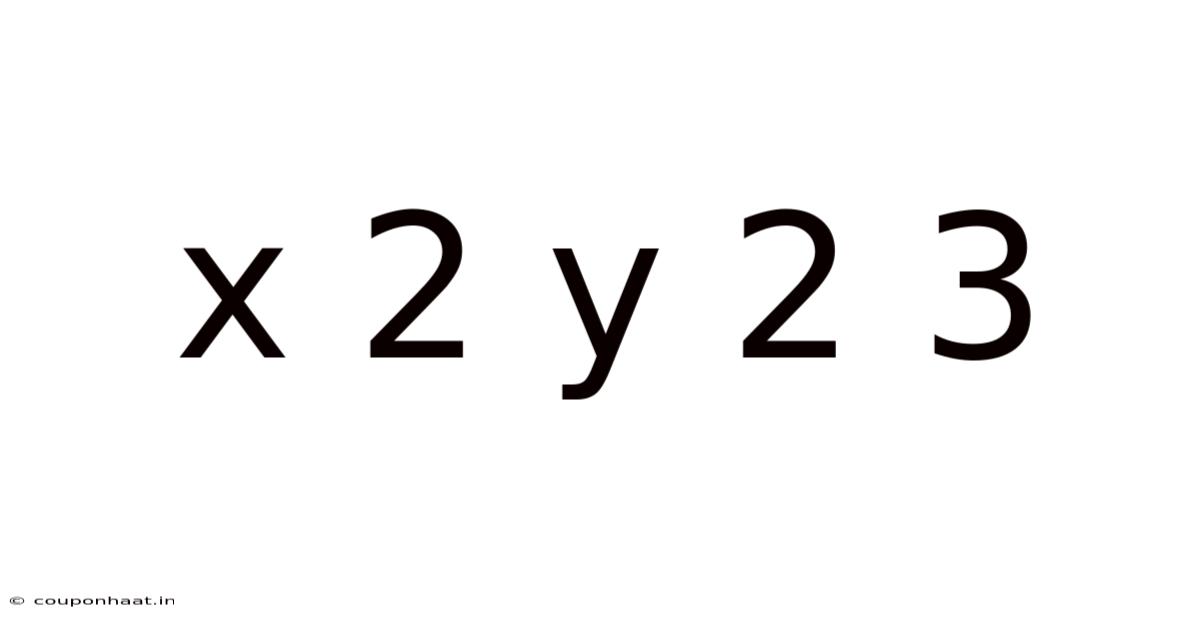
Decoding x² + y² = 3: A Journey Through Geometry and Number Theory
The equation x² + y² = 3 might seem deceptively simple at first glance. This seemingly straightforward problem opens a window into fascinating areas of mathematics, including geometry, number theory, and the intricacies of solving quadratic equations. It's a Diophantine equation, meaning we're searching for integer solutions – whole numbers that satisfy the equation. This article will delve deep into understanding this equation, exploring its solutions, the underlying mathematical concepts, and some related extensions Turns out it matters..
Introduction: Visualizing the Equation
Before jumping into the algebraic manipulation, let's visualize the equation. This constraint dramatically reduces the possibilities. Now, this immediately gives us a geometric perspective: we are looking for points on this circle whose coordinates (x, y) are both integers. On top of that, x² + y² = 3 represents a circle centered at the origin (0,0) with a radius of √3. Can we find any such points?
Searching for Integer Solutions
Let's try some simple integer values for x and y It's one of those things that adds up..
- If x = 0, then y² = 3, which has no integer solution.
- If x = 1, then y² = 2, which also has no integer solution.
- If x = 2, then y² = -1, which has no real solution (and certainly no integer solution).
- If x = -1, -2, etc., we'll find similar results.
This systematic approach already hints at a crucial point: finding integer solutions for x² + y² = 3 is not trivial. Also, it might seem like there are no solutions. Let's proceed to a more rigorous method.
A Deeper Dive into Number Theory
To formally prove the absence of integer solutions, we can take advantage of some properties of quadratic residues. In practice, a quadratic residue modulo n is a quadratic remainder; that is, a number a such that there exists an integer x satisfying x² ≡ a (mod n). In simpler terms, it's a number that can be expressed as a perfect square when considered within a modulo system Easy to understand, harder to ignore. Simple as that..
Honestly, this part trips people up more than it should.
Consider the equation modulo 3. If we reduce the equation x² + y² = 3 modulo 3, we get:
x² + y² ≡ 0 (mod 3)
Now, let's examine the quadratic residues modulo 3. Worth adding: the possible values of x² modulo 3 are 0 and 1 (since 0² ≡ 0, 1² ≡ 1, and 2² ≡ 1 (mod 3)). Similarly, the possible values of y² modulo 3 are 0 and 1 But it adds up..
Short version: it depends. Long version — keep reading.
The only way the sum x² + y² can be congruent to 0 modulo 3 is if both x² ≡ 0 (mod 3) and y² ≡ 0 (mod 3). In real terms, this implies that both x and y must be multiples of 3. Let's say x = 3a and y = 3b, where 'a' and 'b' are integers.
(3a)² + (3b)² = 3
9a² + 9b² = 3
Dividing by 3:
3a² + 3b² = 1
This equation has no integer solutions because the left side is always divisible by 3, while the right side is not. Because of this, our original equation, x² + y² = 3, has no integer solutions Worth keeping that in mind..
Extending the Analysis: Variations and Related Equations
While x² + y² = 3 has no integer solutions, exploring variations helps solidify our understanding Worth knowing..
-
x² + y² = n: The general case of finding integer solutions for x² + y² = n depends heavily on the prime factorization of n. Fermat's theorem on sums of two squares provides a powerful tool for analyzing this problem. This theorem states that an odd prime number p can be expressed as the sum of two squares (p = x² + y²) if and only if p ≡ 1 (mod 4). The case for composite numbers is more complex and involves their prime factorization.
-
x² - y² = 3: This equation can be factored as (x-y)(x+y) = 3. Since 3 is a prime number, the only integer factor pairs are (1,3) and (-1,-3). This leads to systems of linear equations that yield integer solutions And it works..
-
x² + y² = 4: This equation represents a circle with radius 2. Integer solutions include (2,0), (0,2), (-2,0), (0,-2).
-
Adding constraints: We could introduce additional constraints, such as requiring x and y to be positive integers, or restricting them to a specific range. These modifications change the nature of the problem significantly.
The Importance of Modular Arithmetic
The technique used to solve x² + y² = 3 highlighted the power of modular arithmetic. Reducing the equation modulo 3 allowed us to derive a contradiction, proving the absence of integer solutions efficiently. Modular arithmetic is a fundamental tool in number theory, cryptography, and various other branches of mathematics, enabling the analysis of equations and relationships in a simplified, yet informative way The details matter here..
Frequently Asked Questions (FAQ)
-
Q: What are Diophantine equations?
- A: Diophantine equations are polynomial equations where only integer solutions are sought. They are named after the ancient Greek mathematician Diophantus. The equation x² + y² = 3 is a classic example of a Diophantine equation.
-
Q: Are there any real solutions to x² + y² = 3?
- A: Yes, infinitely many. The equation represents a circle with radius √3, and any point on this circle constitutes a real solution. The lack of integer solutions is the key aspect of the problem.
-
Q: How does Fermat's theorem on sums of two squares relate to this?
- A: Fermat's theorem helps determine which integers can be expressed as the sum of two squares. While it doesn't directly solve x² + y² = 3, it provides a framework for analyzing similar equations with different values on the right-hand side.
-
Q: Can this equation be solved using other methods besides modular arithmetic?
- A: While modular arithmetic offers a concise and elegant solution, other approaches involving quadratic forms and number theory concepts could also be employed.
Conclusion: Beyond the Equation
The seemingly simple equation x² + y² = 3 serves as a gateway to a rich landscape of mathematical concepts. Its solution, or rather the lack thereof in integers, highlights the power of number theory, the elegance of modular arithmetic, and the surprising depth that can be found even in seemingly basic mathematical problems. This journey into solving (or rather, proving unsolvability) reinforces the interconnectedness of different mathematical fields and showcases the beauty and intricacy of mathematical reasoning. Further exploration into related Diophantine equations, quadratic residues, and Fermat's theorems will undoubtedly reveal even more mathematical wonders. The quest for integer solutions, even in seemingly simple cases, often leads to profound mathematical discoveries Less friction, more output..
