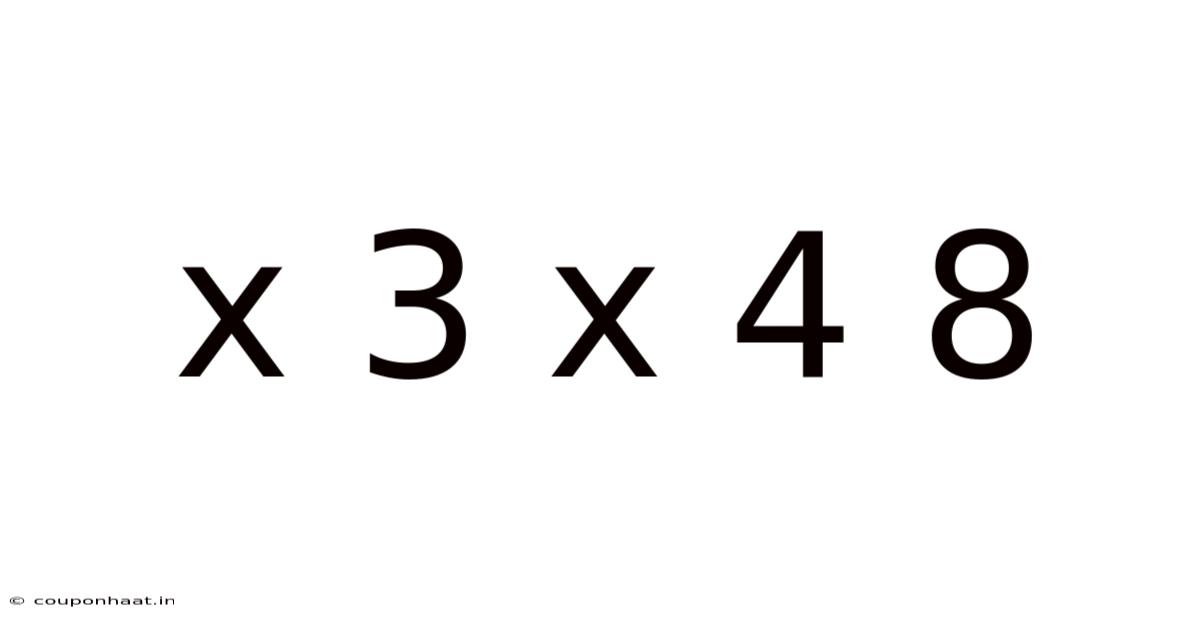
Decoding the Mystery: Exploring the Mathematical Relationship in "x 3 x 4 = 8"
This article looks at the intriguing mathematical puzzle presented by the equation "x 3 x 4 = 8.On the flip side, " At first glance, this seems like a simple multiplication problem, but a deeper investigation reveals a fascinating exploration of algebraic manipulation, potential ambiguities, and the importance of precise mathematical notation. On the flip side, we'll uncover the solution, discuss different interpretations, and explore related concepts to broaden your understanding. This full breakdown is perfect for anyone curious about the underlying principles of mathematics and problem-solving Most people skip this — try not to..
Understanding the Problem: Ambiguity and Interpretation
The core of the problem lies in the ambiguity of the notation. Day to day, the equation "x 3 x 4 = 8" lacks explicit parentheses or other clear indicators of the order of operations. This lack of precision creates multiple potential interpretations, each leading to a different solution for 'x' The details matter here..
Let's explore these interpretations:
-
Interpretation 1: Standard Order of Operations (PEMDAS/BODMAS): Following the widely accepted order of operations (Parentheses/Brackets, Exponents/Orders, Multiplication and Division from left to right, Addition and Subtraction from left to right), we would interpret the equation as: (x * 3) * 4 = 8. This simplifies to 12x = 8, and solving for x gives us x = 8/12 = 2/3.
-
Interpretation 2: Alternative Grouping: It's conceivable that the equation intends to group the operations differently. Take this: it might represent x * (3 * 4) = 8, leading to 12x = 8, and again, x = 2/3. This shows that even if the order of operations is changed, we could still end up with the same solution That's the part that actually makes a difference. But it adds up..
-
Interpretation 3: Implicit Operations: A more complex possibility is that the "x" represents a variable in some unknown context. Perhaps it implies a system of equations, or a mathematical operation more complex than simple multiplication. Without further context or constraints, we cannot definitively solve this scenario Small thing, real impact. Worth knowing..
Solving for 'x' in the Standard Interpretation
The most straightforward and likely interpretation is the application of the standard order of operations (PEMDAS/BODMAS). Let's break down the solution step-by-step:
-
Original Equation: x 3 x 4 = 8
-
Implicit Multiplication: We assume the equation represents (x * 3) * 4 = 8. This is because, in the absence of explicit grouping symbols (like parentheses), multiplication is performed from left to right Which is the point..
-
Simplify: This simplifies to 12x = 8 It's one of those things that adds up..
-
Isolate 'x': To isolate 'x', we divide both sides of the equation by 12: x = 8/12
-
Simplify the Fraction: Reducing the fraction to its simplest form, we get x = 2/3 Not complicated — just consistent..
That's why, under the standard order of operations, the solution to the equation x 3 x 4 = 8 is x = 2/3.
Expanding the Understanding: Exploring Related Concepts
The simple equation "x 3 x 4 = 8" opens doors to a broader understanding of several crucial mathematical concepts. Let's explore some of these:
-
Order of Operations: This problem highlights the critical importance of the order of operations. The seemingly simple equation yields vastly different results depending on how we interpret the sequence of operations. Always use parentheses to clarify your intentions and avoid ambiguity.
-
Algebraic Manipulation: Solving for 'x' requires basic algebraic manipulation, specifically the use of inverse operations (division in this case) to isolate the variable.
-
Fractions and Decimals: The solution is a fraction (2/3). This reinforces the importance of understanding and working comfortably with fractions and their decimal equivalents (approximately 0.667).
-
Variable Representation: The 'x' acts as a variable, a symbol representing an unknown quantity. This introduces the fundamental concept of variables in algebraic equations It's one of those things that adds up. Surprisingly effective..
-
Equation Solving: This simple problem demonstrates the fundamental process of solving equations, a cornerstone skill in algebra and beyond Easy to understand, harder to ignore..
Frequently Asked Questions (FAQ)
Q1: What if the equation was written as x(3)(4) = 8?
A1: The parentheses would explicitly define the order of operations, resulting in 12x = 8 and thus x = 2/3 – the same solution as in the standard interpretation Most people skip this — try not to..
Q2: Are there any other possible interpretations of the equation?
A2: Yes, although less likely. We could interpret "x 3 x 4" to imply some unconventional mathematical operation beyond simple multiplication, which is not readily apparent. Without further context or definition of the unusual operation, there is no concrete solution to offer No workaround needed..
Q3: Why is precise mathematical notation important?
A3: Precise notation prevents ambiguity and ensures that mathematical statements are interpreted correctly. In real terms, the lack of clarity in the original equation underscores this point. Always use parentheses or other unambiguous symbols to indicate the intended order of operations.
Q4: How does this relate to more complex mathematical problems?
A4: While this seems like a simple problem, the principles involved—order of operations, algebraic manipulation, and equation solving—are fundamental concepts used extensively in more advanced mathematics, including calculus, linear algebra, and beyond That's the part that actually makes a difference..
Illustrative Examples: Applying the Concepts
Let's consider similar problems that use the same principle, showcasing different scenarios:
Example 1: x + 2 x 3 = 11
Using the order of operations, we interpret this as (x + 2) * 3 = 11. Following algebraic manipulation, we get x = 11/3 - 2 = 5/3 It's one of those things that adds up..
Example 2: 2x - 5 x 4 = 6
Again, following the order of operations: (2x - 5) * 4 = 6. This simplifies to 8x - 20 = 6, leading to 8x = 26, and ultimately, x = 13/4 Practical, not theoretical..
These examples demonstrate the consistent application of the order of operations and algebraic manipulation.
Conclusion: The Importance of Precision and Critical Thinking
The seemingly simple equation "x 3 x 4 = 8" serves as a powerful illustration of the importance of precise mathematical notation and the need for critical thinking in problem-solving. Consider this: the ambiguity inherent in the original equation highlighted the necessity of clearly defining the order of operations. Which means while the standard interpretation leads to a straightforward solution (x = 2/3), the exercise also opens up avenues for exploring related mathematical concepts and reinforcing fundamental skills in algebra and equation solving. By understanding the different interpretations and applying the principles of order of operations and algebraic manipulation, we can approach more complex mathematical problems with increased confidence and precision. This problem serves as a valuable reminder to pay close attention to detail and ensure clarity in our mathematical expressions to avoid ambiguity and ensure accurate solutions. The journey of unraveling this seemingly simple puzzle has broadened our understanding of fundamental mathematical concepts and the significance of clear communication in mathematics.
