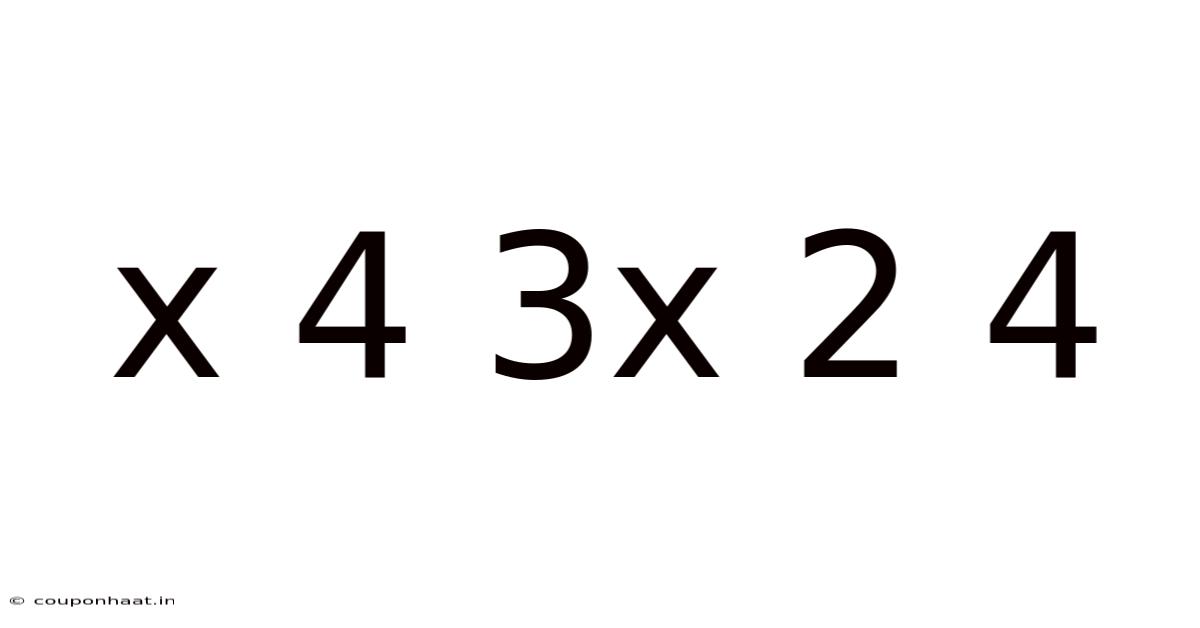
Decoding the Mystery: Exploring the Mathematical Expression "x⁴ + 3x² + 4"
This article breaks down the mathematical expression x⁴ + 3x² + 4, exploring its properties, potential solutions, and the broader mathematical concepts it exemplifies. Understanding this seemingly simple expression opens doors to a deeper appreciation of polynomial equations, factorization techniques, and the power of mathematical analysis. We will dissect this expression step-by-step, making it accessible to readers with varying levels of mathematical background Less friction, more output..
Introduction: Unveiling the Polynomial
The expression x⁴ + 3x² + 4 represents a polynomial equation of the fourth degree, also known as a quartic polynomial. It's characterized by its highest power of x being 4. Think about it: unlike simpler linear or quadratic equations, quartic polynomials can have more complex solutions and require different approaches to solve. This exploration will focus on analyzing its structure, identifying potential methods for finding its roots (solutions where the equation equals zero), and discussing the underlying mathematical principles involved. We'll also consider how this seemingly simple expression connects to broader mathematical ideas and techniques That's the whole idea..
Understanding Polynomial Equations: A Quick Refresher
Before diving into the specifics of x⁴ + 3x² + 4, let's briefly recap some fundamental concepts about polynomial equations. A polynomial is an expression consisting of variables (like x), coefficients (numbers multiplying the variables), and exponents (powers of the variables). The degree of a polynomial is determined by the highest exponent.
- Linear Equation (degree 1): 2x + 5 = 0
- Quadratic Equation (degree 2): x² - 4x + 3 = 0
- Cubic Equation (degree 3): x³ + 2x² - x - 2 = 0
- Quartic Equation (degree 4): x⁴ + 3x² + 4 = 0 (our focus)
The roots, or solutions, of a polynomial equation are the values of x that make the equation equal to zero. Finding these roots can be straightforward for lower-degree polynomials but becomes increasingly complex as the degree increases.
Attempting Factorization: A Direct Approach
A common technique for solving polynomial equations is factorization. In practice, factorization involves rewriting the polynomial as a product of simpler expressions. Unfortunately, directly factoring x⁴ + 3x² + 4 proves challenging. That's why there are no readily apparent factors. We can try substituting different values for x to see if we can find roots, but that is only efficient for simpler polynomials. But unlike quadratics where we can use simple techniques like completing the square, there's no equivalent easy method for quartic equations. We must explore alternative strategies Less friction, more output..
Employing Numerical Methods: Approximating the Roots
For many polynomial equations, especially those of higher degrees, finding exact solutions analytically can be difficult or even impossible. In such cases, numerical methods are employed to approximate the roots. These methods involve iterative procedures that progressively refine an initial guess to obtain a solution within a desired level of accuracy.
- Newton-Raphson Method: This iterative method uses the derivative of the polynomial to refine the approximation of the root in each iteration.
- Bisection Method: This method repeatedly divides an interval containing the root in half, narrowing down the range until the root is found within a specified tolerance.
- Secant Method: Similar to the Newton-Raphson method, but it approximates the derivative using two points instead of calculating the derivative explicitly.
These methods, while not providing exact solutions, offer highly accurate approximations, especially valuable when dealing with polynomials that lack straightforward analytical solutions. Applying these methods to x⁴ + 3x² + 4 would require computational tools or specialized software.
Exploring the Complex Plane: Imaginary and Complex Roots
While real numbers are familiar, the solution to this equation might involve complex numbers. Day to day, complex numbers consist of a real part and an imaginary part, where the imaginary unit i is defined as the square root of -1 (i² = -1). Many higher-degree polynomial equations have solutions that fall within the complex plane – a two-dimensional space where the horizontal axis represents the real part and the vertical axis represents the imaginary part That alone is useful..
So, the Fundamental Theorem of Algebra guarantees that a polynomial of degree n has exactly n roots (including multiplicity) in the complex plane. That's why, our quartic equation, x⁴ + 3x² + 4 = 0, must have four roots, which might be real, imaginary, or a combination of both.
Substitution for Simplification: A Strategic Approach
We can simplify the quartic equation through a substitution. Let's replace x² with a new variable, say 'u'. This transforms the equation into a quadratic equation:
u² + 3u + 4 = 0
This quadratic equation can be solved using the quadratic formula:
u = [-b ± √(b² - 4ac)] / 2a
Where a = 1, b = 3, and c = 4. Plugging in these values:
u = [-3 ± √(3² - 4 * 1 * 4)] / 2 * 1 u = [-3 ± √(-7)] / 2 u = [-3 ± i√7] / 2
This reveals two complex solutions for 'u'. To find the values of x, we need to take the square root of these complex solutions for 'u'. Remember, u = x². This will yield four distinct solutions in the complex plane, reflecting the four roots guaranteed by the Fundamental Theorem of Algebra Worth keeping that in mind..
Finding the Roots: Completing the Solution
We found two solutions for u: u₁ = (-3 + i√7)/2 and u₂ = (-3 - i√7)/2. Now, since u = x², we have:
x² = (-3 + i√7)/2 and x² = (-3 - i√7)/2
Taking the square root of each complex number will yield two solutions for x for each u. The process is slightly involved, but it results in four distinct complex roots for the original quartic equation. On top of that, this involves converting the complex numbers to polar form and then applying the square root. it helps to note that these roots will be complex conjugates, meaning that if a + bi is a root, then a - bi will also be a root But it adds up..
Applications and Extensions: Beyond the Equation
The analysis of x⁴ + 3x² + 4 extends beyond simply finding its roots. The techniques employed, such as substitution and the use of numerical methods, are widely applicable to a vast range of problems in various fields, including:
- Engineering: Solving complex equations in structural analysis, circuit design, and control systems.
- Physics: Modeling oscillations, wave phenomena, and other dynamic systems.
- Computer Science: Developing algorithms for optimization and approximation problems.
- Economics: Analyzing market models and predicting economic trends.
Understanding polynomial equations and their solution methods forms a critical foundation for advanced mathematical concepts and their diverse applications.
Frequently Asked Questions (FAQ)
-
Q: Can this equation be solved without using complex numbers? A: No. The discriminant of the derived quadratic equation is negative, indicating that the roots of the quadratic (and thus the original quartic) are complex The details matter here..
-
Q: Are there other ways to solve this quartic equation? A: Yes, other numerical methods could be employed, such as the secant method or the bisection method, but these would likely also involve computational tools for precise solutions. More advanced techniques from Galois theory could be employed, but this would introduce significantly more complex concepts Simple as that..
-
Q: What is the significance of the Fundamental Theorem of Algebra? A: The Fundamental Theorem of Algebra is a cornerstone of algebra. It establishes that every non-constant single-variable polynomial with complex coefficients has at least one complex root. This fundamental theorem ensures that every polynomial equation has a complete set of solutions within the complex plane.
Conclusion: A Comprehensive Exploration
The seemingly straightforward mathematical expression x⁴ + 3x² + 4 has led us on a journey exploring various mathematical concepts and techniques. Now, from the fundamental properties of polynomial equations to the intricacies of complex numbers and the power of numerical methods, this exploration underscores the depth and interconnectedness within mathematics. This exploration not only reveals the solutions to the equation but also provides a valuable framework for approaching other complex mathematical problems. While the exact solution involves complex numbers, the process of arriving at the solution showcases the elegance and rigor of mathematical analysis. The journey highlights the importance of understanding the underlying mathematical principles and the availability of diverse tools to tackle even seemingly simple expressions.
