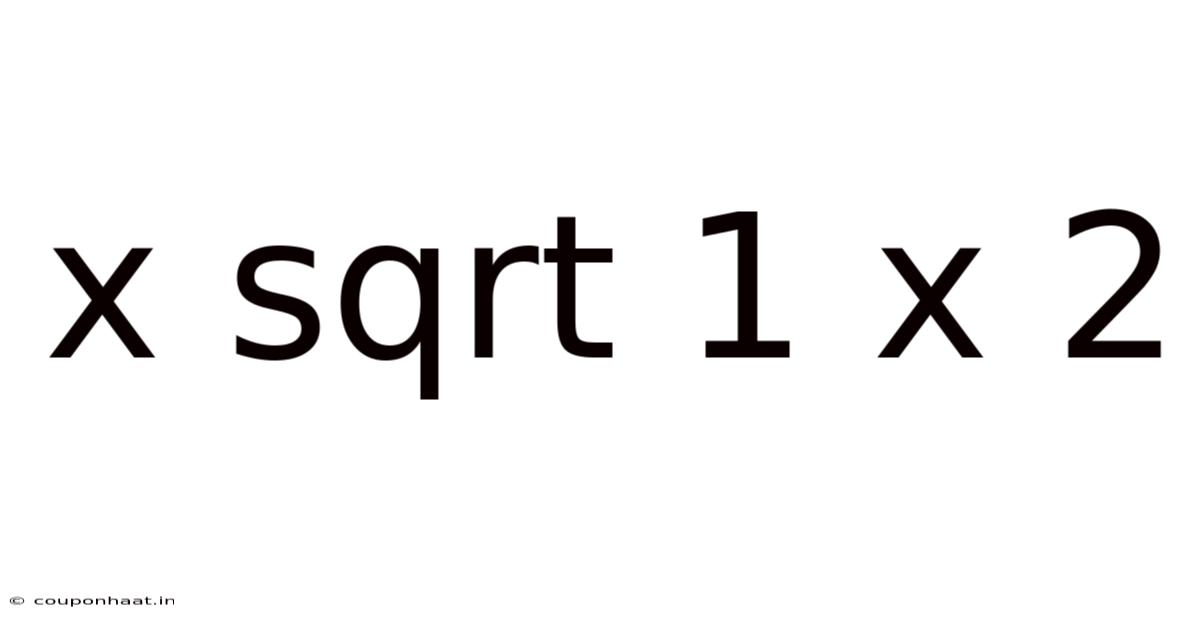
Unveiling the Mysteries of x√(1+x²) : A Deep Dive into Mathematical Exploration
Understanding the expression x√(1+x²) requires a multifaceted approach, blending algebraic manipulation, geometric interpretations, and even a touch of calculus. This seemingly simple expression hides a rich tapestry of mathematical concepts, applicable in various fields from physics and engineering to computer graphics and beyond. This article will guide you through a comprehensive exploration, breaking down the complexities and revealing its underlying beauty That's the part that actually makes a difference..
Introduction: Decoding the Expression
The expression x√(1+x²) represents a function of a single variable, x. Beyond that, we will explore how this expression arises in various contexts and what insights its analysis provides. Even so, we will look at its properties, explore ways to simplify it (under certain circumstances), and uncover its geometric meaning. That's why it combines algebraic operations (multiplication and square root) with a fundamental mathematical constant (implicitly, the number 1). At first glance, it might seem straightforward, but its significance becomes apparent when we consider its applications and interpretations. Understanding this expression opens doors to a deeper appreciation of mathematical relationships and problem-solving techniques.
Algebraic Manipulation and Simplification
The expression x√(1+x²) doesn't readily simplify into a more compact form without imposing specific conditions or applying specific transformations. Even so, we can manipulate it to reveal certain properties and relationships. Here's a good example: we can consider its behavior for specific values of x:
- x = 0: The expression evaluates to 0.
- x = 1: The expression becomes 1√(1+1) = √2 ≈ 1.414.
- x = -1: The expression becomes -1√(1+1) = -√2 ≈ -1.414.
These values offer initial insights into the function's behavior. Notice that the function is odd, meaning f(-x) = -f(x). This symmetry is a key characteristic that will be further explored later. We cannot simplify it algebraically into a purely rational form; the presence of the square root necessitates numerical evaluation for most values of x.
Geometric Interpretation: Unveiling the Relationship with Right-Angled Triangles
A powerful way to understand x√(1+x²) is through geometry. Consider a right-angled triangle with legs of length x and 1. By the Pythagorean theorem, the hypotenuse (let's call it h) has a length:
h² = x² + 1²
Which means, h = √(1+x²) That's the part that actually makes a difference. Which is the point..
Now, notice that our original expression, x√(1+x²), can be rewritten as:
x * h
This geometric interpretation reveals that the expression represents the area of a rectangle with sides of length x and h, where h is the hypotenuse of a right-angled triangle with one leg of length x and the other of length 1. This connection to geometry provides valuable intuition about the expression's magnitude and behavior Most people skip this — try not to..
Calculus and the Derivative: Exploring Rate of Change
Employing calculus, we can explore the rate of change of the function. This involves calculating the derivative of x√(1+x²). Using the product rule and the chain rule, we get:
d/dx [x√(1+x²)] = √(1+x²) + x * [1/(2√(1+x²))] * 2x = √(1+x²) + x²/√(1+x²) = (1+x²+x²)/√(1+x²) = (1+2x²)/√(1+x²)
This derivative represents the instantaneous rate of change of the function at any given point x. Analyzing this derivative can reveal information about the function's monotonicity (whether it's increasing or decreasing), concavity (whether it's curving upwards or downwards), and the location of any critical points (where the derivative is zero or undefined). This further deepens our understanding of the function's behavior.
Applications in Various Fields
The expression x√(1+x²) appears in various contexts, highlighting its mathematical importance:
- Physics: It might emerge in calculations involving vectors and their magnitudes, particularly in problems involving forces and velocities. The Pythagorean theorem, underlying the expression's geometric interpretation, is central to many physics problems.
- Engineering: Similar to physics, engineering applications often involve vector calculations. Civil engineering, mechanical engineering, and electrical engineering all frequently make use of vector analysis where this expression could arise.
- Computer Graphics: In 3D graphics, vector calculations are fundamental. This expression could represent the magnitude of a vector or be part of a more complex transformation calculation.
- Mathematics Itself: The expression serves as a valuable example in illustrating concepts in algebra, calculus, and geometry. Its study helps solidify fundamental mathematical principles.
Frequently Asked Questions (FAQ)
Q: Can this expression be simplified further?
A: Not significantly without specific constraints or transformations. The presence of the square root prevents algebraic simplification to a purely rational form.
Q: What is the domain of the function?
A: The domain of the function is all real numbers, since the expression is defined for any real value of x Easy to understand, harder to ignore..
Q: What is the range of the function?
A: The range of the function is all real numbers. As x approaches positive infinity, the function approaches positive infinity; as x approaches negative infinity, the function approaches negative infinity Simple, but easy to overlook. No workaround needed..
Q: Are there any special values of x that yield interesting results?
A: While x=0 yields 0, values like x=1 (yielding √2) demonstrate its connection to the Pythagorean theorem and irrational numbers.
Q: How can I visualize this function?
A: The best way to visualize it is by graphing it using graphing software or a calculator. Observe its shape, symmetry, and asymptotic behavior.
Conclusion: A Journey of Mathematical Discovery
The seemingly simple expression x√(1+x²) has led us on a fascinating exploration through the realms of algebra, geometry, and calculus. Remember, mathematical exploration is a journey of discovery, and even seemingly simple expressions can reveal profound mathematical insights. The exploration of x√(1+x²) serves as an excellent example of this process. This analysis demonstrates that deeper understanding often lies beyond the initial presentation, requiring a blend of techniques and a keen eye for the underlying relationships. We've uncovered its geometric interpretation as the area of a rectangle related to a right-angled triangle, explored its derivative to understand its rate of change, and highlighted its relevance in various scientific and technical applications. The more we explore, the more we appreciate the interconnectedness and beauty of mathematics.
